
How to Make Yogurt in a Yogurt Maker: Time, Temperature & Thick Results
October 18, 2026
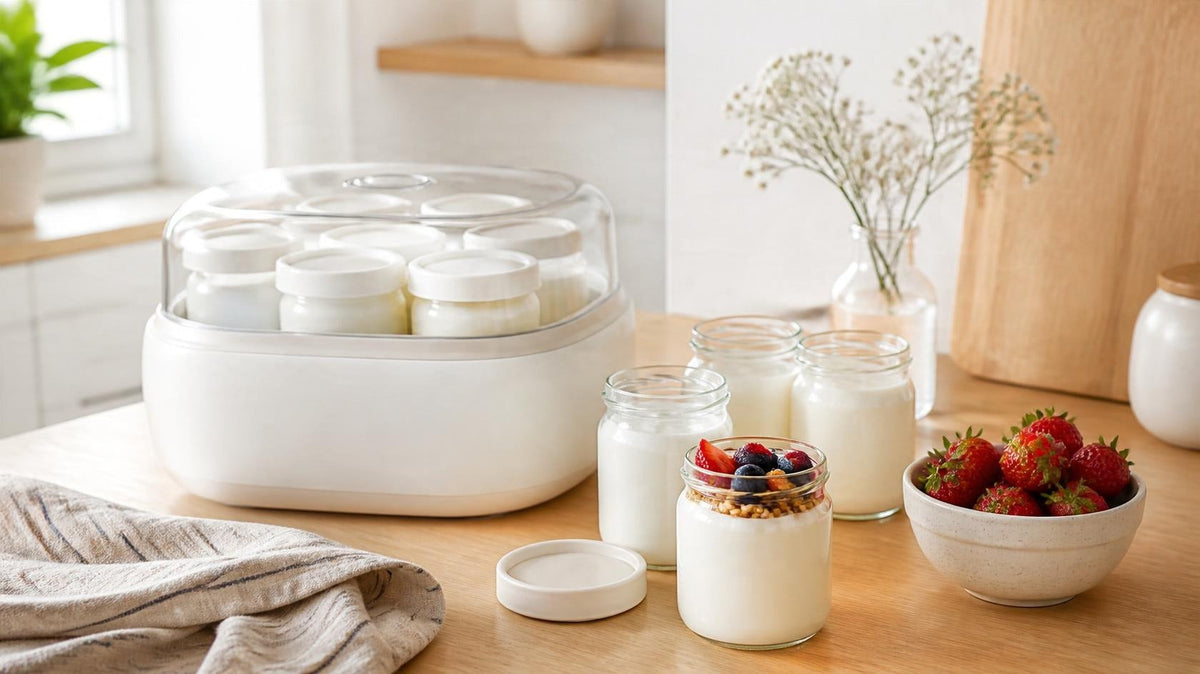
Picture Sunday evening. You warm a quart of milk, stir in a few spoonfuls of plain yogurt, pour it into jars and go to bed. On Monday morning there's a week of breakfasts waiting in the fridge, and it cost you the price of the milk. That's the appeal of making yogurt at home, and a yogurt maker takes the guesswork out of the one hard part: keeping the milk warm and steady for hours. How to make yogurt in a yogurt maker, how long to leave it, and what to change when a batch comes out thin or too sour.
The short version
- Heat the milk to 180–185°F (82–85°C), then let it cool to 108–115°F (42–46°C) before adding starter.
- Use 2–3 teaspoons of live-culture yogurt per cup of milk.
- Incubate at about 110°F (43°C) for roughly 4–10 hours, until it sets.
- Chill right away. For thicker yogurt, heat the milk longer or strain after chilling.
What you need before you start
The shopping list is short. You need milk, a starter and a way to keep it warm. Whole milk gives the creamiest, fullest yogurt, but low-fat milk works too; the University of Illinois Extension recipe uses 1% milk. For the starter, a plain store-bought yogurt that says "live and active cultures" is the easiest option. Use it before its date, because fresher starter has more active bacteria. Once you've made a batch, a spoonful of your own yogurt can start the next one within 5–7 days. Freeze-dried cultures are another route; just follow the packet.
A food thermometer is the one tool worth buying if you don't have one. Every step below depends on temperature, and guessing is where most first batches go wrong. The yogurt maker handles the long middle part. Ours, the Youlva yogurt maker with 6 glass jars, lets you set both the time and the temperature on a digital panel, and each jar has its own lid so the batch goes straight from machine to fridge.
How to make yogurt in a yogurt maker, step by step
With the milk and starter ready, the process takes about half an hour of hands-on time, most of it waiting for milk to heat and cool. These steps follow the method in the extension guides we cite at the end.
1. Heat the milk to 180–185°F
Warm the milk slowly in a saucepan, stirring now and then so it doesn't scorch on the bottom. You're aiming for 180–185°F (82–85°C). This step isn't about pasteurizing store-bought milk again. It changes the milk proteins so they set into a smooth gel instead of loose curds. The University of Alaska Fairbanks guide suggests holding that heat for 10 minutes for thinner yogurt or up to 20 minutes for thicker yogurt. Don't let it boil.
2. Cool it to 108–115°F
Take the pan off the heat and let it cool to 108–115°F (42–46°C). Setting the pan in a sink of cold water speeds this up. Be patient here. Add the starter while the milk is still too hot and you can kill the cultures you're relying on.
3. Mix in the starter
Ladle about a cup of the warm milk into a small bowl and stir in the starter until smooth. Oregon State's guide uses 2–3 teaspoons of starter per cup of milk, so roughly 2½–4 tablespoons for a quart. Pour that back into the pan and stir gently. Mixing it into a small amount first stops the starter from clumping.
4. Fill the jars and set the yogurt maker
Divide the milk among clean jars and place them in the machine. For standard cultures, set the yogurt maker temperature to about 110°F (43°C), or follow your culture's instructions if you're using a packet. Set the timer, fit the cover and leave it alone. Moving or opening the jars while they set can break the gel.
5. Chill as soon as it sets
When the yogurt has set like a soft custard, cap the jars and move them to the fridge at 40°F (4°C) or below. Cold stops the bacteria from making more acid, so the flavor stays where you like it. It will firm up a little more as it chills.
| Stage | Temperature | Notes |
|---|---|---|
| Heat the milk | 180–185°F (82–85°C) | Hold 10 minutes for softer yogurt, up to 20 for thicker |
| Cool before adding starter | 108–115°F (42–46°C) | Too hot can harm the cultures |
| Incubate | About 110°F (43°C) | Usually 4–10 hours, until it sets |
| Chill | 40°F (4°C) or below | Stops the souring; eat within about 7–14 days |
How long to ferment yogurt in a yogurt maker
Most people get stuck here, and the honest answer is that it depends on your temperature, starter and taste. At around 110°F, extension guides give a window of roughly 4–10 hours. Alaska Fairbanks says 4–7 hours, Oregon State says 6–8 and Illinois says 6–10. Yogourmet, which makes starter cultures, says a minimum of 5 hours for its standard yogurt.
Time controls tang more than anything. Yogurt keeps souring after it sets, and if you leave it far too long the whey starts to separate. On the r/yogurtmaking forum, some home makers go 12–24 hours on purpose for a thicker, sharper result, while one commenter points out that a time means little unless you also know the temperature. Our advice: check at 6 hours, tilt a jar gently, and stop when it holds together and tastes right to you. Write down the time. That's your number for next week.
How to make thick yogurt in a yogurt maker
If your yogurt sets but feels thinner than the tubs you buy, you have three levers. The first is heat. Holding the milk at 185°F for the full 20 minutes, rather than just touching it, gives a firmer set. The second is milk solids. The Alaska Fairbanks guide adds nonfat dry milk powder to the cold milk before heating for extra body. Stir it in before the milk warms, or it can form strings.
The third, and the most dramatic, is straining, which is how you get Greek yogurt in a yogurt maker. Make plain yogurt as usual, chill it, then spoon it into a sieve lined with cheesecloth over a bowl and leave it in the fridge. Yogourmet's timings are a good guide: 1–2 hours for thick, 3–4 hours for Greek-style and 6 hours or more for very thick. Don't pour away the whey that drips out; it works well in a smoothie or in baking.
When a batch goes wrong
A runny batch usually traces back to one of four things: the milk wasn't heated long enough, the starter was old or didn't contain live cultures, the incubation temperature drifted, or the yogurt simply needed more time. Change one of those on the next batch rather than all four, so you know which one fixed it.
Too sour means it fermented longer than you like, so pull it earlier next time. If you see a layer of yellowish liquid on top, that's whey, and it usually means the batch went well past setting. You can stir it back in or pour it off. What you should never ignore is mold, pink or fuzzy spots, or a smell that isn't the clean sourness of yogurt. Throw that batch out and start again with fresh starter and well-cleaned jars.
Storing homemade yogurt
Keep the jars capped in the fridge at 40°F (4°C) or below. Guidance on how long it lasts varies: Yogourmet says 7 days, Illinois says 14 and Alaska Fairbanks gives 10–21. We plan around a week, which is why a six-jar batch fits so neatly into a routine. Save one jar's last spoonfuls as the starter for the next round.
Your first batch this week
Pick an evening and make one quart. Heat it to 185°F and hold it for 10 minutes, cool it to 110°F, stir in 3 tablespoons of plain live-culture yogurt, fill the jars and set the machine to 110°F. Check at 6 hours and note how it looks and tastes. If you want it thicker next time, hold the milk hot for 20 minutes. If you want it tangier, add an hour. By the third batch you'll have a recipe that's yours, and you'll wonder why you ever bought the little tubs. Everything else for an easy breakfast routine is in our cooking and food preparation collection.
Recommended for you
Once yogurt is part of your week, these two make the rest of breakfast easier.

Warm breakfasts
Ceramic Slow Cooker & Steamer, 1 L
Porridge and oats to serve under your yogurt. $69.99
View product
Yogurt smoothies
Portable Blender, 630 mL
USB-C rechargeable, for fruit and yogurt drinks. $39.99
View productYogurt maker FAQ
How long does yogurt take in a yogurt maker?
Most batches set in about 4–10 hours at around 110°F (43°C). Start checking at 6 hours. The longer it goes after setting, the tangier it gets.
What temperature should a yogurt maker be set to?
Around 110°F (43°C) works for standard yogurt cultures. Extension guides allow roughly 108–115°F. If you use a packaged culture, follow its instructions.
Why is my homemade yogurt runny?
The usual causes are milk that wasn't heated long enough, a weak or old starter, an incubation temperature that drifted, or simply not enough time. Fix one at a time on the next batch.
Can I use store-bought yogurt as a starter?
Yes, as long as it's plain and says it contains live and active cultures. Use it before its date. A spoonful from your own batch also works within 5–7 days.
How do I make Greek yogurt in a yogurt maker?
Make plain yogurt as usual, chill it, then strain it in the fridge through cheesecloth or a fine strainer. Around 3–4 hours gives a Greek-style texture.
How long does homemade yogurt last in the fridge?
Kept at 40°F (4°C) or below, plan on about 7–14 days. Throw out anything with mold or an off smell that isn't the clean sourness of yogurt.
Ready for your first batch? Everything for an easy homemade breakfast is in one place.
Shop cooking & food prepSources
- University of Illinois Extension: Making Yogurt at Home, for heating and cooling temperatures, 6–10 hour incubation, starter freshness and 14-day storage.
- University of Alaska Fairbanks Cooperative Extension: Making Yogurt at Home, for heat-hold times, dry milk powder, 4–7 hour incubation and storage.
- Oregon State University Extension: Yogurt Made Simple, for starter amounts and 6–8 hour incubation.
- Yogourmet: Yogurt directions, for minimum incubation time, straining times and 7-day storage.
- r/yogurtmaking: How long do you leave your yoghurt to incubate?, for home makers' experience with longer ferments.
Youlva product details were checked against current listings on October 18, 2026.