
How to Clean a Stainless Steel Tumbler: Lid, Gasket, Straw, Smells & Stains
October 26, 2026
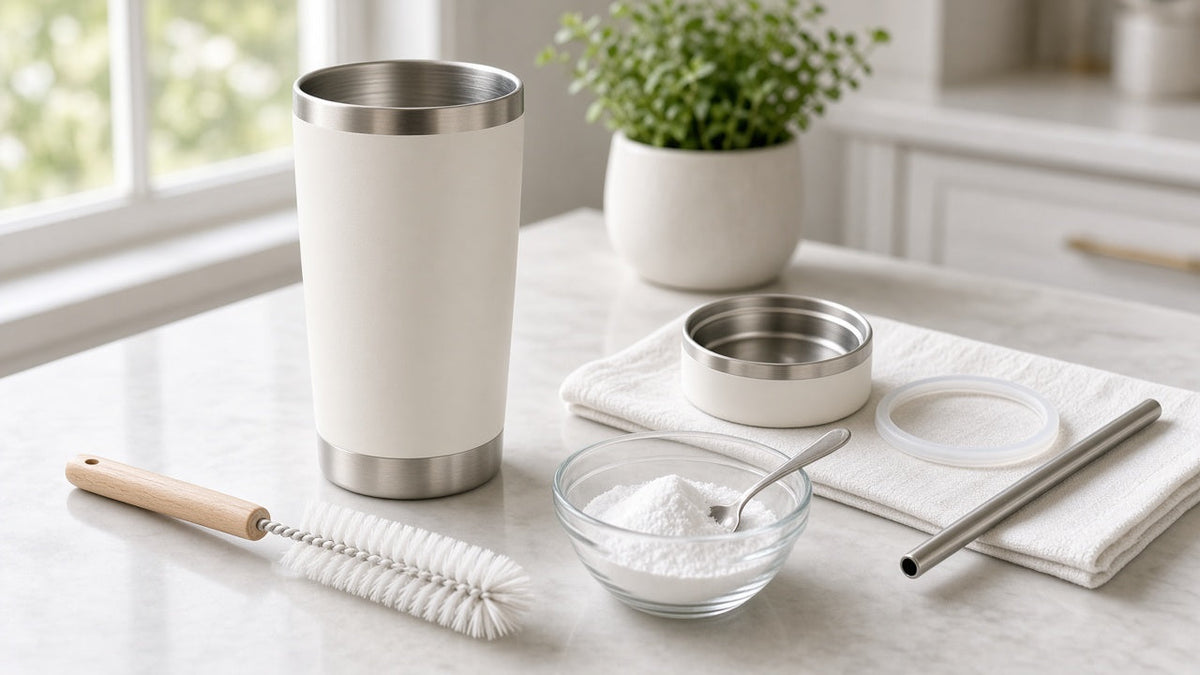
You unscrew the lid on Monday morning and get a whiff of something sour. The steel inside looks fine, the cup went through the sink on Friday, and yet last week's peach iced tea is still hanging around. We hear about this more than any other drinkware question, and the fix is rarely a new cup. Knowing how to clean a stainless steel tumbler mostly comes down to the parts people skip: the gasket, the straw and the little flip cap. Below is the routine we use ourselves, a weekly soak for smells, and what to do about tea stains, water spots and spots that might be mold.
The short version
- Wash the cup, lid, gasket and straw in warm soapy water after each use, and don't put it back together until every piece is dry.
- For smells, leave 1 to 2 tablespoons of baking soda in warm water for at least 30 minutes; if that isn't enough, follow with equal parts white vinegar and water for 15 to 30 minutes.
- When a tumbler smells, the lid gasket is usually to blame, not the steel. Take it out and clean it on its own.
- Skip bleach, steel wool and scouring pads, and never boil or dishwasher a tumbler that says hand wash only.
Why a clean-looking tumbler still smells
The steel is rarely the problem. Stainless steel doesn't soak up much, so the smell is living somewhere else: in the lid threads, around the silicone gasket, inside the straw, under the drinking spout. Thermos puts it plainly. A bottle that smells almost always has leftover drink residue and wasn't dried properly. Water leaves very little behind. Sweet tea, smoothies, protein shakes and anything with milk in it leave a lot more. If your tumbler mostly carries smoothies, rinse it as soon as it's empty, the same advice we give in our portable blender guide.
The two-minute daily wash
Stanley's everyday routine is the one we'd hand to anyone. Empty the cup, take off every part that comes off, wash it all in warm water with a mild dish soap, rinse, and let it dry before you put it back together. A long bottle brush gets to the bottom of the cup and a small brush handles the lid. Zojirushi's manual for its stainless mugs says to clean after every use to keep odours and mold away, which sounds fussy until you've had to deal with mold. Leave the body upside down on a rack with the lid off overnight and it's ready in the morning.
A weekly soak with baking soda and vinegar
Once a week, or the day you notice a smell, give it a longer soak. Thermos has you put 1 to 2 tablespoons of baking soda in the tumbler, fill it about halfway with warm water, shake it, and leave it for at least 30 minutes, overnight if the smell is strong. If there's still an odour after that, pour in equal parts white vinegar and water for 15 to 30 minutes and then rinse several times. Stanley's version is gentler on measuring: hot water, a teaspoon of baking soda and a splash of vinegar, left for a few hours or overnight. Either way, rinse until you can't smell vinegar any more, or your next drink will taste of it.
How to clean a tumbler lid and gasket
This is the part that makes the difference. Thermos calls the gasket the single most important piece to clean, because it holds on to moisture and residue between uses. Ease it out with a fingernail or a toothpick and try not to stretch it, since a stretched ring stops sealing well. Scrub both faces, and the groove it sits in, with a soft toothbrush and soap. If the lid still smells after that, give the gasket its own soak in baking soda solution. Flip caps and spouts need opening up too; residue dries underneath them where you can't see it. On a lid like the one on our Insulated Tumbler with Handle & Straw 710 mL, that means pulling out the sip-spout stopper and the straw and washing each one.
Straws, tea filters and glass inserts
Push a straw brush through the straw from both ends after each use. A quick rinse doesn't reach the middle. Tea filters and infusers should come out, get rinsed and get a brush across the slots before the leaves dry in place. This is where design starts to matter, because some tumblers come apart completely and some don't. The Insulated Tumbler with Removable Glass Insert 900 mL has a borosilicate glass insert that lifts out and an opening of about 95 mm, so your hand reaches the bottom. The Ceramic-Coated Insulated Tumbler 735 mL has sealing rings you can remove, a removable infuser and a ceramic-coated interior.
Tea stains, water spots and rust spots
Tea will tan the inside of steel if you drink enough of it, and soap alone won't lift it. Hydro Flask's fix is a paste of 2 to 3 tablespoons of baking soda with just enough warm water to hold together, worked onto the stain with a bottle brush. For residue that won't budge, Hydro Flask mixes half a cup of hydrogen peroxide with 2 tablespoons of baking soda, leaves it for 30 minutes, then washes as normal. Water spots and the odd small rust spot are a different job. Zojirushi suggests filling the cup with hot water containing 10% vinegar and leaving it 30 minutes to an hour with the lid off. If you brew loose-leaf tea on the go, the removable basket in our Stainless Steel Travel Tumbler 750 mL with Tea Filter keeps the leaves out of the cup, so less colour ends up on the walls.
Which fix for which problem
Here's the short form for the drawer by the sink. Amounts come from the sources at the end of the page.
| Problem | What to use | How long | Notes |
|---|---|---|---|
| Everyday residue | Warm water, mild dish soap, bottle brush | A few minutes | Take the lid apart every time |
| Sour or musty smell | 1–2 tbsp baking soda in warm water | 30 min to overnight | Then equal parts vinegar and water, 15–30 min, if needed |
| Smell only in the lid | Gasket out, soak in baking soda solution | 30 min | Dry fully before refitting |
| Tea stains | Baking soda paste on a bottle brush | Scrub until gone | Or ½ cup hydrogen peroxide + 2 tbsp baking soda, 30 min |
| Water spots, rust spots | Hot water with 10% vinegar, lid off | 30–60 min | Rinse thoroughly afterwards |
| Black dots on the gasket | Scrub and soak; replace if they stay | 15–30 min | Likely mold; parts can be replaced |
Mold: clean it or replace it?
Dark marks on a gasket could be tea or could be mold, and from a distance it's hard to tell. One r/CleaningTips thread asked exactly this about a gasket on a tumbler used for iced tea all day, and the replies split between scrubbing, soaking and simply buying a new one. Our view: scrub and soak first. If the spots are still there afterwards, replace the gasket or the lid rather than fighting it. Zojirushi recommends looking the lid over about once a year and replacing plastic parts that are damaged or have gone rough. And if the smell keeps coming back after a proper clean, suspect a part of the lid you can't take apart. One r/StanleyCups owner found mold tucked inside a pop-up straw lid that looked spotless from the outside.
What not to do
Keep bleach and chlorine cleaners away from it. Hydro Flask says they can damage stainless steel and make it rust, and Zojirushi warns against bleach too. Never mix bleach with vinegar: the Washington State Department of Health lists vinegar among the acids that react with bleach to release chlorine gas. Steel wool, scouring powders and melamine sponges scratch the surface, so leave them in the cupboard. Don't boil the tumbler, and don't leave the body soaking for hours. The dishwasher is only an option if the maker says so, and every Youlva tumbler in this guide is hand wash only. Last, give the pieces time to dry before you put them away, because a lid reassembled damp is a lid that smells by Wednesday. If you carry meals as well as drinks, our electric lunch box guide covers the food-safety side.
Recommended for you

Loose-leaf tea
Stainless Steel Travel Tumbler 750 mL
SUS316 interior, a tea filter that lifts out, a dual-drink lid with straw spout and a folding handle. Hand wash. $39.99
View product
Iced drinks
Insulated Tumbler with Handle & Straw 710 mL
Vacuum insulated with a SUS316 interior, a removable lid, stoppered sip spout and straw. Hand wash. $29.99
View product
Glass inside
Glass Insert Straw Tumbler 590 mL
A borosilicate glass cup inside a 304 stainless steel sleeve; lid, straw and dust cap all separate for washing. $29.99
View productHow to clean a stainless steel tumbler: FAQ
How do you clean a stainless steel tumbler with baking soda?
Put 1 to 2 tablespoons of baking soda in the tumbler, fill it about halfway with warm water, shake, and leave it for at least 30 minutes, or overnight if the smell is strong. Then wash with soap and rinse well.
Can you clean a stainless steel tumbler with vinegar?
Yes. Equal parts white vinegar and water for 15 to 30 minutes helps with smells, and hot water with about 10% vinegar shifts water spots. Rinse thoroughly afterwards, and never combine vinegar with bleach.
How do you clean a tumbler lid gasket?
Ease the gasket out without stretching it, scrub both sides and the groove with soap and a soft toothbrush, soak it in baking soda solution if it still smells, and let it dry completely before you refit it.
How do I get the smell out of my tumbler?
Start with the lid, because the gasket is usually the source. Then soak the body with baking soda and warm water, and finish with a diluted vinegar rinse if any smell is left.
Can I put my stainless steel tumbler in the dishwasher?
Only if the maker says it's dishwasher safe. Plenty of vacuum-insulated tumblers, including the Youlva tumblers in this guide, are hand wash only.
Is it mold or a tea stain on my tumbler lid?
Brown tinting is often just tea. Black or fuzzy spots on a gasket are more likely mold. If they're still there after scrubbing and soaking, replace the gasket or the lid.
Tonight, pull the gasket out of your lid, drop it in a bowl of warm water with a spoonful of baking soda, and leave every piece on a towel to dry until morning before you put it back together.
Browse Youlva DrinkwareSources
- Thermos: How to Clean a Stainless Steel Water Bottle, for the weekly deep clean, baking soda and vinegar soaks and cleaning the gasket separately.
- Stanley 1913: How to Clean Your Stanley 1913, for the everyday routine and the baking soda and vinegar soak.
- Hydro Flask Singapore: FAQs, for bleach and chlorine warnings and the baking soda paste.
- Hydro Flask: 3 Ways to Clean a Bottle, for the hydrogen peroxide and baking soda deep clean.
- Zojirushi SU-C Stainless Mug instruction manual (PDF), for cleaning after each use, the 10% vinegar soak, what not to use and checking the lid yearly.
- Washington State Department of Health: Dangers of Mixing Bleach with Cleaners, for not mixing bleach with vinegar.
- r/CleaningTips: How to clean the rubber gasket on a water tumbler lid?, for the stained-or-moldy gasket discussion.
- r/StanleyCups: Mold on Stanley Tumbler Lid, for mold hidden inside a lid that washed clean on the surface.
Youlva product details were checked against current listings on October 26, 2026.