
Is Titanium Cookware Worth It? Safety, Sticking and Price vs Stainless Steel and Nonstick
November 17, 2026
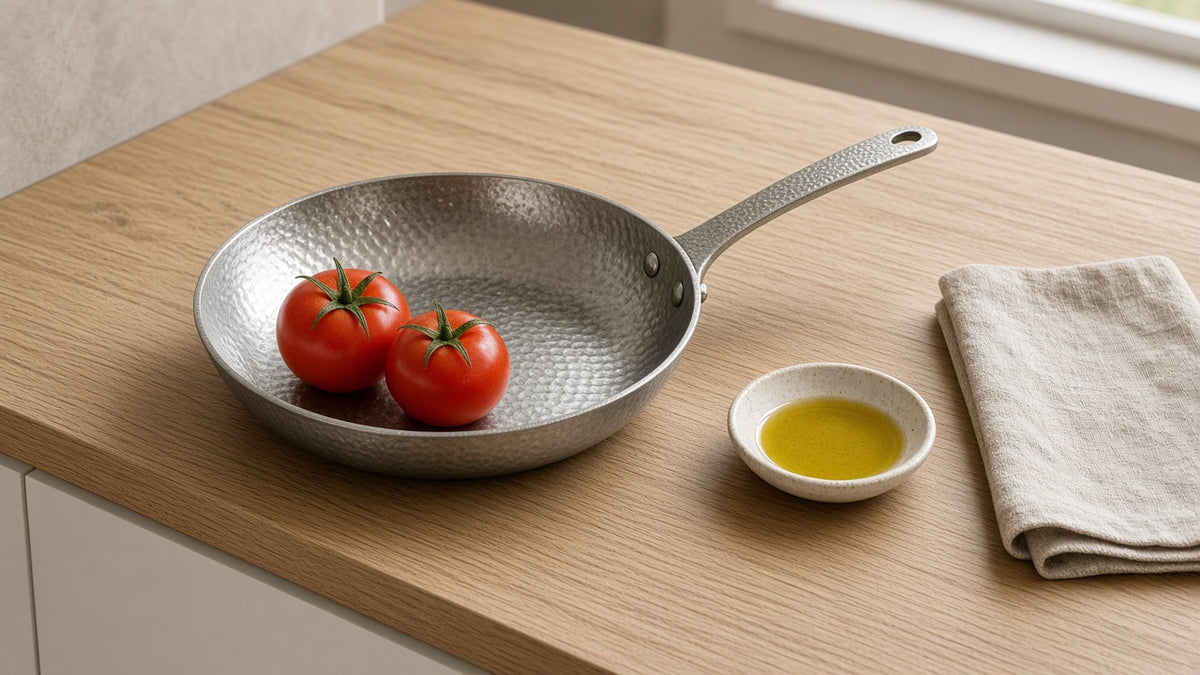
Picture the tab you have open right now: a pan with "100% pure titanium" in big letters, a Black Friday countdown clock, and a 4.9 rating nobody can check. You want to know one thing. Is titanium cookware worth it, or is it a very shiny way to buy a pan that sticks? My answer is that it is worth it for a particular cook. You want a pan with no coating to flake, and you do not mind preheating it the way you would a stainless pan. If you want eggs to slide around with zero effort, it is not your pan.
The short version
- Worth it if you want an uncoated pan and will preheat it with a little oil. Skip it if easy egg release is your main reason for buying.
- Read the label: pure titanium surface, titanium-clad, titanium-strengthened steel and titanium-reinforced nonstick are four different pans.
- A bare titanium surface is inert and considered safe for food. The weak spot is heat spread: titanium conducts about 22 W/m·K, aluminium about 236.
- Listed prices for a 28 cm pure-titanium pan ran from $79.99 to $239 on the shops I checked. The Youlva pan starts at $99.99.
So, is titanium cookware worth it?
Compare it with what is in your cupboard now. If a flaking nonstick pan is the problem, an uncoated titanium pan fixes that and should outlast it. If you already own decent stainless, you will not feel a leap. Business Insider points out that most "titanium" cookware is not solid titanium at all, and when Prudent Reviews tested one of the pricier titanium pans, an egg cooked without fat stuck as badly as it did on plain stainless steel.
The hype is not imaginary, though. Rising Trends puts "titanium cookware" at 74,000 US searches a month in mid-2026, up from about 3,600 two years earlier, and ties the jump to Black Friday ad spend from direct-to-consumer brands. That is why every second pan now carries the word, and why the listing matters more than the headline.
What the word titanium actually means on a pan
Four different products hide behind it. A pure titanium pan puts bare titanium against your food. A titanium-clad pan bonds a thin titanium layer onto an aluminium core and a steel base. Titanium-strengthened stainless is steel with titanium in the alloy. The cheap end is a nonstick coating with titanium particles stirred in, and there the coating is still what you cook on. Rising Trends found prices from $159.95 for a titanium-strengthened steel pan up to $450 for a skillet with a molecular titanium layer, all ranking for the same search.
The Youlva pure titanium hammered frying pan is listed as an uncoated, hammered titanium surface with a rivet-free interior, in 26, 28 or 30 cm, for induction and gas. It is sold without a lid. Be aware of what the listing does not say: thickness, weight and the layers underneath all come from the supplier and are not spelled out. I would ask for those on any pan before paying, ours included.
Is titanium cookware safe?
For the bare metal, yes. Business Insider calls titanium cookware non-toxic and safe for everyday cooking, since the metal is non-reactive and corrosion-resistant, so tomato sauce and vinegar do not pull anything off it. Untitan, summarising the Council of Europe guide on metals in food contact, says titanium is described there as practically inert. That covers the metal. It does not cover a coating with titanium dust in it, where the coating decides everything.
Coatings are the reason many people are shopping at all. Researchers at Flinders University reported that one scratch on a Teflon-coated pan could release around 9,100 plastic particles, though that was a dry lab test without food or oil. Consumer Reports adds a plain durability point: nonstick wears out first, and once it is scratched, eggs stop sliding. An uncoated pan removes that failure mode. It does not remove the need for technique.
Does a titanium pan stick?
It can, and the reasons are boring. Bare metal has no slick layer, so egg white grabs it the way it grabs stainless. On top of that, titanium moves heat badly. Engineering ToolBox lists roughly 22 W/m·K for titanium against about 236 for aluminium and 14 for 304 stainless. A thin pure-titanium pan therefore runs hot over the burner and cool at the rim, and Prudent Reviews measured a 140-degree gap between centre and edge on one thin pan. Hot spots are what burn food and make it cling.
What works: centre the pan on the burner, heat it empty on medium for a few minutes, add a little oil, drop the heat, then add the food. Plenty of Reddit owners still report sticking even with oil, so go in expecting a learning curve. I walk through the whole routine in our guide to cooking eggs in a titanium pan.
Titanium vs stainless steel vs nonstick
| Pure titanium surface | Stainless steel | Nonstick (PTFE or ceramic) | |
|---|---|---|---|
| Food release | Needs preheat and fat | Needs preheat and fat | Best straight from the box |
| Lifespan | Long, no coating to wear | Very long | Shortest, the coating wears |
| Heat spread | Poor unless bonded to aluminium | Good when clad with aluminium | Good, usually aluminium |
| Hot searing | Fine with technique | Excellent | Not recommended |
| Coating concerns | None on a bare surface | None | Depends on the coating |
| Upkeep | Hand wash, no scouring pads | Forgiving, tolerates scrubbing | Soft tools, replace in a few years |
Against stainless, titanium wins on weight and on being fully non-reactive, and that is about it. Against nonstick it wins on lifespan and on coating worries, and loses on easy release. Rank them on a first egg and it goes nonstick, then titanium and stainless level, both leaning on the cook.
What a titanium pan should cost
Prices I saw listed this week for a 28 cm pure-titanium skillet: $79.99 on Amazon, $99.95 at Titan's Kitchen, $139.95 at Collins Cookware, $149.95 at Titanium Wares, $239 at Titaner. Our Place and Hestan sit above that. Plenty of those are on permanent "sale", so the crossed-out number tells you nothing. The Youlva 28 cm is $109.99, and the 26 cm is $99.99.
Before you pay anyone, check four things. Thickness, because a 2 mm pan bowed in the Prudent Reviews test. Induction, because pure titanium is not magnetic and a pan needs a steel base to work; a fridge magnet on the bottom answers that in a second. Weight. And whether the seller states what the cooking surface actually is.
Who should buy one, and who should not
Buy titanium if flaking coatings bother you, you cook a lot of tomato or wine sauces, you like a lighter pan, and you are happy to learn your burner. Skip it if eggs and pancakes are most of what you cook, if you want a pan that forgives a cold start, or if your budget is under $50. For eggs alone, a six-egg cooker does the job with no technique at all.
Looking after it
Let it cool, wash by hand with a soft sponge, skip scouring pads on the hammered surface, and dry it. Burnt-on food and rainbow heat marks are covered in how to clean a titanium pan. Do not run cold water into a hot pan.
If you do buy one, the first night goes like this: hold a magnet to the base if you cook on induction, preheat on medium, flick in a few drops of water, and fry a single egg before you trust it with dinner.
Recommended for you

Soups and sauces
Hammered Titanium Saucepan
1.5 L, 2 L or 2.5 L with a wooden handle and pouring lips. Induction, gas and electric ceramic. Pan only, no lid. $69.99.
View product
Tools to match
Titanium Cooking Utensil Set, 4 Pieces
Wok spatula, slotted turner, ladle and skimmer with titanium heads and stainless handles. $99.99.
View product
If eggs are the goal
Electric Egg Cooker, 6 Eggs
200 W, one-touch button, clear lid, removable rack. $39.99.
View productIs Titanium Cookware Worth It? FAQ
Is titanium cookware worth it?
If you want a pan with no coating and you will preheat it properly, yes. If you want eggs to slide out with no effort, a nonstick pan is the better buy and titanium will frustrate you.
Is titanium cookware safe?
A bare titanium surface is inert, and Business Insider calls it non-toxic for everyday cooking. The caveat is the label: a nonstick coating with titanium mixed in is still a coating, and its safety depends on that coating and on not overheating or scratching it.
Is a titanium pan better than stainless steel?
It is lighter and does not react with acidic food, but it does not cook better. Titanium spreads heat poorly unless it is bonded to an aluminium core, and stainless needs the same preheat-and-oil routine.
Is titanium cookware nonstick?
Not in the way a PTFE pan is. Bare titanium releases food when the pan is properly heated and has a little fat in it. Cold pan, no oil, cold egg: it will stick.
Do titanium pans work on induction?
Only if the base is magnetic. Pure titanium is not, so induction pans need a steel layer underneath. The Youlva listing says induction and gas; if induction is your only hob, hold a fridge magnet to the base when it arrives.
Can a titanium pan warp?
A thin one can. Prudent Reviews found a 2 mm clad titanium pan bowed after a few uses. Do not plunge a hot pan into cold water, and ask the seller for the thickness before you buy.
How much should a titanium frying pan cost?
For a 28 cm pan with a pure titanium surface, the listed prices this week ran from $79.99 to $239 on the shops I checked. Between about $100 and $150 is the range where you should expect a clear spec sheet. The Youlva 28 cm is $109.99.
Looking for more cookware and kitchen tools? Browse the full range.
Shop cooking & food prepSources
- Business Insider, Best Titanium Cookware, accessed 17 Nov 2026.
- Prudent Reviews, Taima Titanium Review, accessed 17 Nov 2026.
- Rising Trends, Titanium Cookware Trends 2026, updated 26 Oct 2026.
- Untitan, Uncoated frying pans, accessed 17 Nov 2026.
- Engineering ToolBox, thermal conductivity of metals, accessed 17 Nov 2026.
- Flinders University, Not-so-tough Teflon, 31 Oct 2022.
- Consumer Reports, frying pans, accessed 17 Nov 2026.
- Titan's Kitchen, Pure Titanium Hammered Pan (price), accessed 17 Nov 2026.
- Collins Cookware, Titanium Hammered Pan (price), accessed 17 Nov 2026.
- Titanium Wares, Frying Pan Pro (price), accessed 17 Nov 2026.
- Titaner, Composite Titanium Frying Pan (price), accessed 17 Nov 2026.
- Amazon listing, 28 cm titanium pan (price), accessed 17 Nov 2026.
Product details checked against the Youlva listings on 17 November 2026.