
Are Electric Lunch Boxes Worth It? Heating Time, Cost vs a Microwave and Who Should Skip One
November 20, 2026
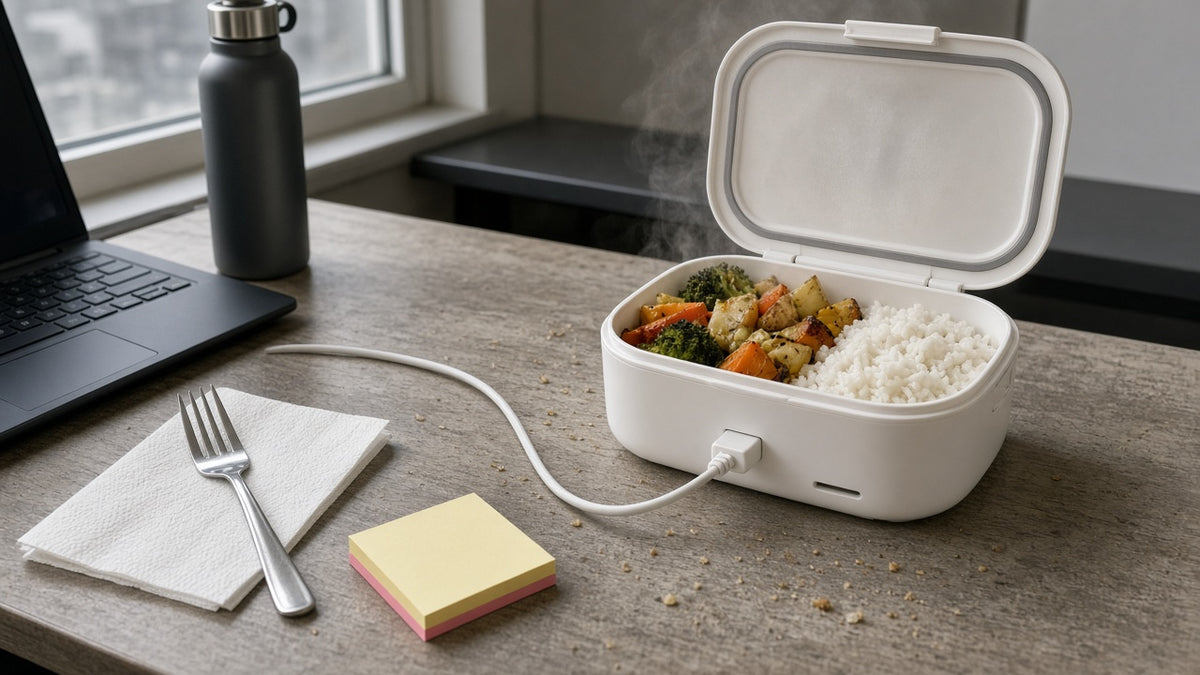
It's 12:10, there are five people queued at the office microwave, and last night's curry is sitting cold in its container on your desk. That's the exact moment an electric lunch box starts to look smart. So, are electric lunch boxes worth it? Yes, if you regularly can't get to a microwave: you're in a van, on a site, in a small office with one shared oven. No, if there's a free one ten steps from your desk. The microwave is faster, it costs nothing, and it's one less thing to wash.
The short version
- Worth it if you have no microwave or can never get to it. Skip it if you have an easy one at work.
- The price you pay is time: published tests and owner reports run from about 20 minutes to 90 minutes, so you plug it in before you need it.
- It warms cooked, chilled food. It does not cook raw ingredients, and it is not a cooler.
- It pays for itself in roughly six or seven packed lunches if it stops you buying lunch (worked example below).
Are electric lunch boxes worth it?
They're worth it for one kind of person, and the people who love them all describe the same situation. A Reddit commenter who owned one called it perfect "if it's what you need but impractical if you don't," and said it earns its place for drivers and delivery workers with no other way to heat food. Another person in the same thread gave theirs up: about 90 minutes to heat a full container, and not much room inside. Both are telling the truth. The box was the same. Their lunch situations weren't.
Heating time is the whole argument. Kitchenfitly says 20 to 45 minutes, KPC's buying guide says about 20 to 40 for basic models, and Kitchen Marts says 20 to 90. Food Network's 2026 testers had a chili bubbling at close to 200°F after just 15 minutes in one model, so the fast end is real. So is the slow end, especially with a full container of dense food straight from a cold fridge. If you plug it in at 11:15 for a 12:15 lunch without thinking about it, you'll be happy. If you only notice you're hungry at noon, you won't.
The second thing people like is how the food comes out. The Kitchn's reviewer said her leftovers tasted much better than they would have from a microwave, and Reddit owners say rice and leftovers do well, with one adding that pasta and curry work best because they fill the whole container and all of it needs heating. The catch, from one of those owners: anything fried goes soggy. Soup, curry, pasta, rice and stew suit it. Crisp food doesn't.
Electric lunch box vs microwave vs thermos: which one fits your day?
Line the three up and the choice gets plain. The microwave wins on speed and price. A thermos food jar wins when you can fill it hot at 7 a.m. and eat at noon with nothing to plug in. The electric lunch box wins in one lane: no microwave in reach, an outlet nearby, and food that starts the day cold.
| Electric lunch box | Office microwave | Thermos food jar | |
|---|---|---|---|
| Heating time | About 20–90 minutes, depending on model and portion | A few minutes, plus any queue | None. It only keeps food hot |
| Needs power | Yes, a wall outlet (or a battery on cordless models) | Yes, but it's provided | No |
| Works with cold food | Yes, it warms chilled cooked food | Yes | No. You fill it with hot food |
| Food texture | Gentle, even warming; crisp foods go soft | Fast; can leave cold spots, needs a stir | Whatever it was when you filled it |
| Upfront cost | One purchase | Free at work | Varies by brand |
| Best for | Drivers, site workers, small offices, shared kitchens with one overloaded microwave | Offices with a free microwave | Commuters who can reheat at home first |
KPC's guide makes the same call and adds a point worth keeping: a thermos is often better than a lunch box if you can fill it with hot food in the morning and don't need to reheat later. That's the honest alternative, and for plenty of people it's the cheaper one.
Does an electric lunch box pay for itself?
Only if it changes what you eat at lunch. Say a bought lunch near you runs $12 and the same meal from home costs $4. That's $8 saved each time, so at $49.99 the box is paid off after about six or seven packed lunches. Those prices are just an example, so swap in your own. The microwave isn't the box's real rival on cost. The $12 sandwich is.
If you already bring lunch every day and have a decent microwave, the box saves you nothing. You'd be buying it for the texture, which is a fine reason, but it's a preference, not a saving.
What do owners complain about?
The same complaints come up in owner threads and reviews. Speed first: "it works but just takes forever to heat up" is a typical line on r/maintenance. Then capacity, since a box that holds one decent portion won't feed two. Then the cord, because you need a socket within reach of wherever you eat. Leaks are next. Saveur's top pick had a lid that wasn't secure enough for thin liquids like broth, so soup travels better in its own container and gets poured in once you're sitting down. Last is washing: one Reddit owner says cleaning is a breeze only if the food container lifts out, because you can't run the heating base under water.
One mistake we see in how people pack: filling the container to the brim with a dense mound of food, then wondering why the middle is cold. Spread it flat, cut big pieces down, and leave a little headroom under the lid.
Ours has a separate food container and a clip-on lid with a steam vent, which helps with the washing and the lid. Speed is the same story as for any heated lunch box: it's slower than a microwave. If that bothers you, don't buy one.
Is an electric lunch box safe?
It's safe when you treat it as a warmer, not a refrigerator. KPC says plainly that a heated lunch box doesn't replace refrigeration, and Kitchenfitly gives the standard rule: keep food cold until you heat it, then bring it to steaming hot, 165°F (74°C) all the way through. In practice you pack cooked food the night before, keep it in a fridge or an insulated bag with ice packs, and plug in about an hour before you eat. Our guide on how to use an electric lunch box walks through the routine, and the one on cleaning an electric lunch box covers the base and container.
Don't leave it plugged in all afternoon either. Check whether your model shuts itself off; plenty don't, and a crust welded to the container is what forgetting costs you. A phone alarm is the cheap fix.
Electric lunch box or a small cooking pot?
These two are easy to confuse if you live in a dorm, a hotel room or a workshop with no kitchen. A lunch box warms food you've already cooked. It isn't meant for raw ingredients. If you want to boil noodles, eggs or a bit of stew from scratch, you want a cooker. Our 1 L portable electric cooking pot has Boil Water, Noodles, Stew, Boil Eggs, Hot Pot and Keep Warm functions, 600 W, and a 304 stainless steel inside. It holds 1 L, so it's a single-serving pot, and you have to be there while it cooks.
If your problem is "my cooked lunch is cold," get the lunch box. If it's "I have no kitchen at all," get the pot.
Who should skip an electric lunch box?
Skip it if your workplace has an easy microwave, if you can fill a thermos with hot food at home, or if you tend to decide about lunch at the last minute. Skip it if you pack mostly crisp, fried or bread-based meals, or if one container has to feed two people. Better to hear it now than to find the box in a drawer in March.
What does our 1.5 L electric lunch box do, and not do?
It holds 1.5 L (51 fl oz) in the orange, blue, green, pink and red versions; the gray one can differ, so ask us before ordering gray. The body is white with colored handle and latches, and the folded size is about 238 × 170 × 108 mm (9.4 × 6.7 × 4.3 in). The lid closes with front and side clips, with a steam vent and a covered recess for a fork. A light on the front shows that it's heating.
Now the limits, straight from the listing. That light means heating is in progress, not that the food is ready. No timer or temperature display is listed, and no 12 V car lead is in the box, so think of it as a wall-socket lunch box. It comes with one power lead, and you pick the plug at checkout: US/CA, AU/NZ, EU or UK. It's for prepared meals, not raw cooking. If you need a car lead or a built-in timer, look at another model.
Before you rely on it, spend one weekend lunch testing it at home. Pack your usual portion, note the time when you plug in, and push a thermometer into the middle at 30, 45 and 60 minutes. The time it first reads 165°F (74°C) is your number. Write it on a sticky note and put it on the lid.
Recommended for you

For the drink
Insulated Travel Tumbler, 750 mL
Dual-sip lid, folding carry handle and SUS316 stainless steel interior. Hand wash only; not for the microwave. $42.99.
View product
For a smoothie
Portable Blender, 500 mL
Four presets for fruit, smoothie, ice and cleaning, with USB-C charging and a flip-top drinking lid. $39.99.
View productFrequently Asked Questions
Are electric lunch boxes worth it?
They are if you don't have regular access to a microwave: drivers, site workers, small offices and shared kitchens with long queues. They are not if you have a free microwave nearby, because the microwave is faster and costs nothing. Expect to plug the box in about an hour before you eat.
Is an electric lunch box better than a microwave?
It depends on the day. A microwave heats in minutes. A lunch box takes anywhere from about 20 to 90 minutes, but it works without a microwave and warms food gently, which suits rice, pasta and stews. Crisp foods go soft in either.
How long does an electric lunch box take to heat food?
Published guides give about 20 to 45 minutes (Kitchenfitly), 20 to 40 (KPC) and 20 to 90 (Kitchen Marts). Portion size, how cold the food starts and the model all matter. We don't publish a time for our box, so test your usual meal once at home.
Is an electric lunch box safe?
Yes, when you use it as a warmer. Keep food chilled until you heat it, pack only cooked food, and bring it to 165°F (74°C) throughout before you eat. A lunch box does not replace refrigeration.
Do electric lunch boxes cook raw food?
No. They are built to warm food that's already cooked. For raw noodles, eggs or a small stew, use a cooker such as our 1 L portable electric cooking pot.
Is an electric lunch box better than a thermos?
A thermos food jar is simpler if you can fill it with hot food in the morning and eat later, since it needs no power. A lunch box is better if you want to pack cold food and warm it at the place you eat.
Can I use the Youlva electric lunch box in a car?
The listing doesn't include a 12 V car lead. It comes with a power lead for a wall outlet, and you choose a US/CA, AU/NZ, EU or UK plug when you order.
Does the Youlva lunch box have a timer or tell me when food is ready?
No timer is listed. The front light shows that the box is heating but not that the food is ready or what temperature it has reached, so check the middle of the food and unplug it when you're done.
Want a warm lunch where there's no microwave? Browse our compact cooking and food prep range.
Shop Compact Cooking & Food PrepSources
- Electric Lunch Box vs Microwave at Work, Kitchenfitly, heating times, 165°F reheating rule, comparison table.
- Electric Lunch Box for the Office and Car, KPC online, 20–40 minute estimate, thermos comparison, refrigeration note.
- Are Electric Lunch Boxes Worth It?, Kitchen Marts, 20–90 minute range.
- 6 Best Electric Heated Lunchboxes 2026, Food Network, chili test, buying criteria.
- Electric Lunchbox, r/Holdmywallet, owner reports on heating time and use cases.
- Lunch-Game Changer, r/maintenance, "takes forever to heat up" owner comment.
- Best Electric Lunch Box for work?, r/mealprep, owner reports on texture and heating.
- Best Electric Lunch Boxes, Saveur, lid and thin-liquid caution.
- Crock-Pot Electric Lunch Box: We Tried It, The Kitchn, taste versus microwave.
Product details checked against the Youlva listings on November 20, 2026.