
Rice Cooker Not Heating? Causes, Fixes and When to Replace It
November 21, 2026
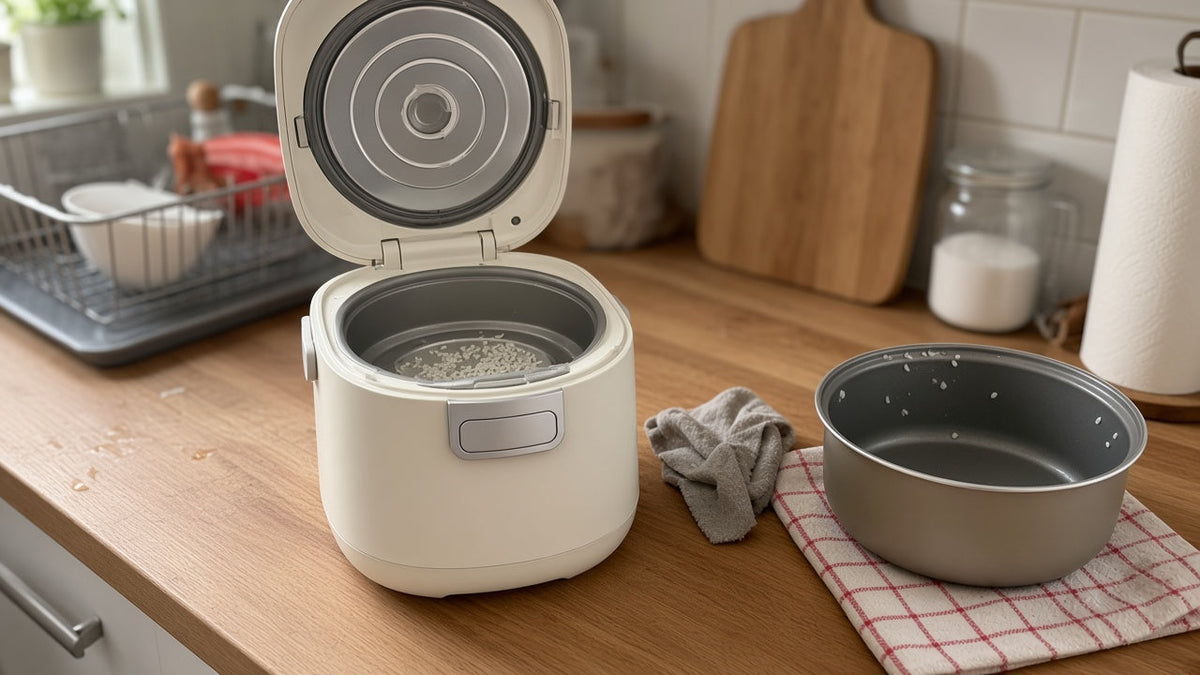
You load the rice, add the water, press Start, and the light comes on like it always does. Twenty minutes later you lift the lid and the water is still cold. A rice cooker not heating has a short list of suspects, and most cost nothing to fix. The power cord may be only half pushed in. The delayed-start timer may be counting down. The sensor may be wearing a coat of dried starch. Rule those out first. If the panel is lit and the pot is still cold after that, a thermal fuse or heating element has very likely failed inside the base, and on a compact cooker it is usually cheaper to replace the machine than to chase the fault.
The short version
- Work through it in order: outlet and cord, lid shut, pot seated flat, then Cancel and a fresh Start. That sequence clears most "rice cooker not working" cases.
- A cooker stuck on Warm, or one that drops to Warm after a few minutes, is usually reading a dirty or wet sensor or a pot that no longer sits flush.
- A lit panel and a cold pot after those checks means a blown thermal fuse or dead heating element. Both are sealed safety parts, not a kitchen-table repair.
- On an $80 cooker, a fault inside the base normally means a new cooker. Our three Youlva rice cookers are $79.99 each and come with a UK or EU plug.
Why is my rice cooker not heating?
Inside the base there is a heating plate under the inner pot, a temperature sensor in the middle of that plate, and a thermal fuse that cuts the power if anything runs too hot. When the pot stays cold, either one of those parts has given up or something is keeping the pot off the plate. The table below matches what you are seeing to the likeliest cause, so you can jump straight to the right fix.
| What you see | Most likely cause | What to try | Fix at home? |
|---|---|---|---|
| No light, no sound, no heat | Cord not seated, dead outlet, or tripped breaker | Reseat the cord at both ends, try another outlet, check the breaker | Yes |
| Light on, pot cold, display counting down | Delayed-start (Preset) timer waiting, or an old program still in memory | Press Cancel, choose the program again, press Start | Yes |
| Light on, pot cold, no timer set | Pot not seated, debris on the plate, or a blown thermal fuse | Reseat the pot, clean the plate, then test with water only | Partly |
| Stuck on Warm, never cooks | Keep Warm still active, or a sensor that thinks the pot is already hot | Cancel, clean the pot bottom and the sensor, restart | Usually |
| Drops to Warm within minutes | Too little rice, dirty sensor, or a dented pot | Cook at least the manual's minimum, clean, do the rocking test | Usually |
| Heats, but rice is raw or crunchy | Water ratio, old dry rice, or a wet pot bottom | Check the ratio, add a little water, dry the pot bottom | Yes |
| Worked for years, now cold with a lit panel | Blown thermal fuse or failed heating element | Stop, unplug, replace the cooker | No |
What should I check first when a rice cooker is not working?
Start with the dull checks, because they rescue more cookers than any repair does. Unplug the cooker and push the power cord all the way into the back of the base. Most compact cookers use a detachable cord, our smallest model included, and a connector that is only half in is the classic reason for a "dead" one. On a digital model, a cord that is not seated or a Preset timer left running are my first two guesses. Try a different outlet. Check the lid has clicked shut. Then lift the inner pot out and drop it back with a small twist, so it sits flat and does not rock.
Next, look at the plug on the wall side. A travel adapter changes the shape of the prongs, not the voltage. A cooker built for 220 to 240 V on a 110 to 120 V outlet will heat badly or not at all, so read the rating label on the underside before you blame the machine.
Why is my rice cooker light on but not heating?
On a digital cooker the panel can look busy while the heater is switched off on purpose. The usual culprit is the Preset timer. With a delay set, the cooker waits out the countdown before it heats, and the display can pass for a cooking cycle. Press Cancel, pick the program again and press Start. Yum Asia's help centre gives the same advice for its models: if Keep Warm or a preset is active, reset it before a new cycle will begin.
Memory is the second culprit. Unplug a cooker mid-cycle without pressing Cancel and many models hold on to the old program. Tiger describes a related quirk. If you change the menu after pressing Start, Cancel may not clear the first cycle, so the start lamp stays lit with no heat, and its advice is to wait 30 minutes to an hour before trying again. Tiger also says its cookers are not meant to run back to back, because the overheat protection can step in.
Still cold? Pour in a cup of water, start a cycle and, after 10 to 15 minutes, carefully touch the outside of the pot. Warm but not boiling means poor contact between pot and plate. Stone cold means the fault is inside the base.
Why is my rice cooker stuck on warm, or switching to warm too early?
A rice cooker knows the rice is done because the bottom of the pot gets hotter than boiling once the water has gone. That jump is its cue to drop into Keep Warm. If the sensor reads the jump too early, or never reads it, you get a cooker that slides to Warm after a few minutes or never leaves it. Panasonic's support page and Town Food's service guide both blame the same things: a dirty sensor, or a pot that is not touching the plate cleanly.
Three causes account for most cases. A grain of rice or a smear of dried starch sits on the sensor. The pot goes in with a wet bottom. Or the pot took a knock at some point and is slightly out of round. Town Food's test for the last one is easy to copy: seat the pot, press down on opposite edges in turn and rock it gently. Any wobble means it is not flush, and shiny scuffs on the underside are another sign of a dent. Cooking too little rice can also fool the sensor, so stay above the minimum in your manual.
How do I clean the heating plate and sensor safely?
Unplug the cooker and let it cool completely. Lift the pot out and tip any crumbs into the bin. Wipe the plate and the little sensor in the centre with a cloth wrung out until it is barely damp, then dry both. For baked-on residue, a soft toothbrush does the job, but keep steel wool away from the plate because it scratches. Town Food suggests tilting the body onto its side while you clean so water never runs into the base, and that is sound advice for any cooker. Dry the outside of the inner pot before it goes back, as Tiger also recommends. Our guide to how to clean a rice cooker goes further, down to the steam vent and burnt-on rice.
Consumer Reports adds a habit worth stealing: go easy on Keep Warm. Left on for hours, it can bake rice onto the pot.
What if it heats but the rice comes out raw or crunchy?
Then the cooker is probably healthy. Measure the water against the lines in the pot instead of by eye, and remember that old rice has dried out and wants a little extra. Xiaomi's support pages suggest adding some when the rice is more than six months old or has been left out to dry. Our rice cooker water ratio guide has the numbers for the common rice types.
Is it a blown thermal fuse or a dead heating element?
If the power, pot, plate and timer all check out and the panel is lit but the pot never warms, the fault is inside the base. The two likely suspects are the thermal fuse and the heating element. The fuse is a one-shot safety part. Panasonic's service manual says it does not reset and has to be replaced once it opens, and that it opens when the pot and heater do not make proper contact or when the cook switch has been forced to stay on. ApplianceJournal's repair guide says a cooker that lights up but never heats almost always has a blown thermal fuse. A thread in r/ElectronicsRepair shows the other outcome, where an owner confirmed the fuse still had continuity and still could not find the fault.
That thread is why I would not open the base of a cooker like ours. A cheap fuse can sit in front of a fault you cannot see, and you would be poking around mains wiring to find out. An experienced repairer with a multimeter and the exact spare can make that call. Everyone else should stop here.
Should I repair or replace a rice cooker that will not heat?
For a compact cooker, replace it.
One lifespan guide puts a basic rice cooker at three to six years, and the usual rule is to replace when the heating element or control board fails or when the repair would cost close to a new unit. A fault inside the base of an $80 cooker is exactly that case. Repair makes sense for a damaged inner pot or a worn lid seal, and only when parts are easy to find. If the cord feels hot, a breaker trips or you smell burning, stop using it straight away.
Which rice cooker should I buy to replace it?
If you cook for one or two, start with the Mini Rice Cooker 1.2 L. It has a steaming dish, Rice, Porridge and Soup modes, and a 2, 4, 8 or 12 hour preset. For a small family the Digital Rice Cooker 2.5 L adds eight menus and a 24-hour preset, while the Compact Rice Cooker with Steamer 2.5 L brings a non-stick inner pot and steaming tray. All three are $79.99 and in stock. Unsure about size? Read what size rice cooker you need first.
| Cooker | Capacity and power | Modes and preset | Plug | Price |
|---|---|---|---|---|
| Mini Rice Cooker 1.2 L | 1.2 L, 200 W | Rice, Porridge, Soup, Keep Warm; preset 2, 4, 8 or 12 h; stainless steel steaming dish | UK (Type G) or EU (Type C/F) | $79.99 |
| Digital Rice Cooker 2.5 L | 2.5 L, 400 W | 8 menus plus Keep Warm; preset up to 24 h; titanium inner liner; steaming tray | UK (Type G) or EU (Type C/F) | $79.99 |
| Compact Rice Cooker with Steamer 2.5 L | 2.5 L, 400 W | 8 functions; preset up to 24 h; non-stick inner pot; steaming tray | UK (Type G) or EU (Type C/F) | $79.99 |
Pick the plug when you order: UK (Type G) or EU (Type C/F), whichever fits your wall sockets. If your sockets take a US/CA or AU/NZ plug, the two cookers below come in those versions. They make porridge, soup, noodles and stews rather than plain rice. When the new one arrives, dry the plate, seat the pot flat, and press Cancel before you ever unplug it.
Recommended for you

Slow soups and porridge
Ceramic Slow Cooker & Steamer 1 L
A 1 L ceramic pot with Porridge, Slow Soup and Keep Warm functions and a delay timer of up to 24 hours. Choose a US/CA, UK, EU or AU/NZ plug. $69.99.
View product
Backup for small meals
Portable Electric Cooking Pot 1 L
A 1 L stainless steel cooker with six functions, including Noodles, Boil Eggs and Stew, that lifts off its base for serving. Choose a US/CA, UK, EU or AU/NZ plug. $49.99.
View productFrequently Asked Questions
Why is my rice cooker not heating but the light is on?
Look for a delayed-start timer first, then press Cancel and restart. After that, reseat the inner pot and wipe the plate. If the pot is still cold after 10 to 15 minutes with water in it, the thermal fuse or heating element has most likely failed and the cooker needs replacing.
Why is my rice cooker stuck on warm?
Either it is still in Keep Warm from an earlier cycle, or its sensor thinks the rice is already done. Press Cancel, clean and dry the pot bottom and the sensor, check the pot sits flat, and cook at least the minimum amount of rice in your manual.
Why is my mini rice cooker not heating?
Run the same checks you would on a big one: cord fully in, pot flat, plate clean, no delay set. A very small batch can also send some cookers to Warm early, so follow the minimum and the fill marks in the manual.
Can a rice cooker be repaired?
Sometimes. A damaged inner pot or a loose cord can be sorted out cheaply. A blown thermal fuse or failed heating element sits inside the sealed base, and on a compact cooker the repair usually costs close to a new one, so replacing it is the practical choice.
How long should I wait between rice cooker batches?
Tiger asks owners to wait 30 minutes to an hour before a second cycle so the cooker can cool down. Check your own manual, because rules differ by brand, and never run a cooker empty.
Which plug does a Youlva rice cooker come with?
You choose a UK (Type G) or EU (Type C/F) plug at checkout, and the cooker arrives with that plug on its cord. The 1.2 L Mini and both 2.5 L models are offered in the two versions, all at $79.99.
Need a rice cooker, slow cooker or small cooking pot that is in stock now? Browse the full compact range.
Shop Compact Cooking & Food PrepSources
- The rice cooker isn't heating up, Tiger Corporation, cord, plate and sensor checks, menu change quirk, 30 to 60 minute wait.
- The commercial rice cooker is not heating, Panasonic, pot seating and debris checks.
- The commercial rice cooker does not stop operating, Panasonic, sensor and pot placement checks.
- Rice cooker service manual, Panasonic, how the thermostat and non-resetting thermal fuse work, causes of fuse failure.
- The rice cooker doesn't cook, Yum Asia Help Centre, detachable cord, Keep Warm and preset checks.
- Hold Mode Troubleshooting for Electric Rice Cookers, Town Food Service Equipment, dirty sensor, dented pot rocking test, cleaning advice.
- How to Clean a Rice Cooker, Consumer Reports, heating plate and sensor cleaning, keep-warm residue.
- Rice Cooker Not Heating? Causes and How to Fix It, ApplianceJournal, thermal fuse and thermostat causes.
- How Long Do Rice Cookers Last?, Fuzzy Logic Rice Cooker, typical lifespan and repair versus replace.
- Tatung rice cooker not heating up, r/ElectronicsRepair, owner report of a lit cooker with no heat.
- Why is the rice undercooked?, Xiaomi support, old rice and sensor checks.
Product details checked against the Youlva listings on November 21, 2026.