
Ceramic Lined Tumbler vs Stainless Steel: Taste, Safety, Titanium & Glass
November 06, 2026
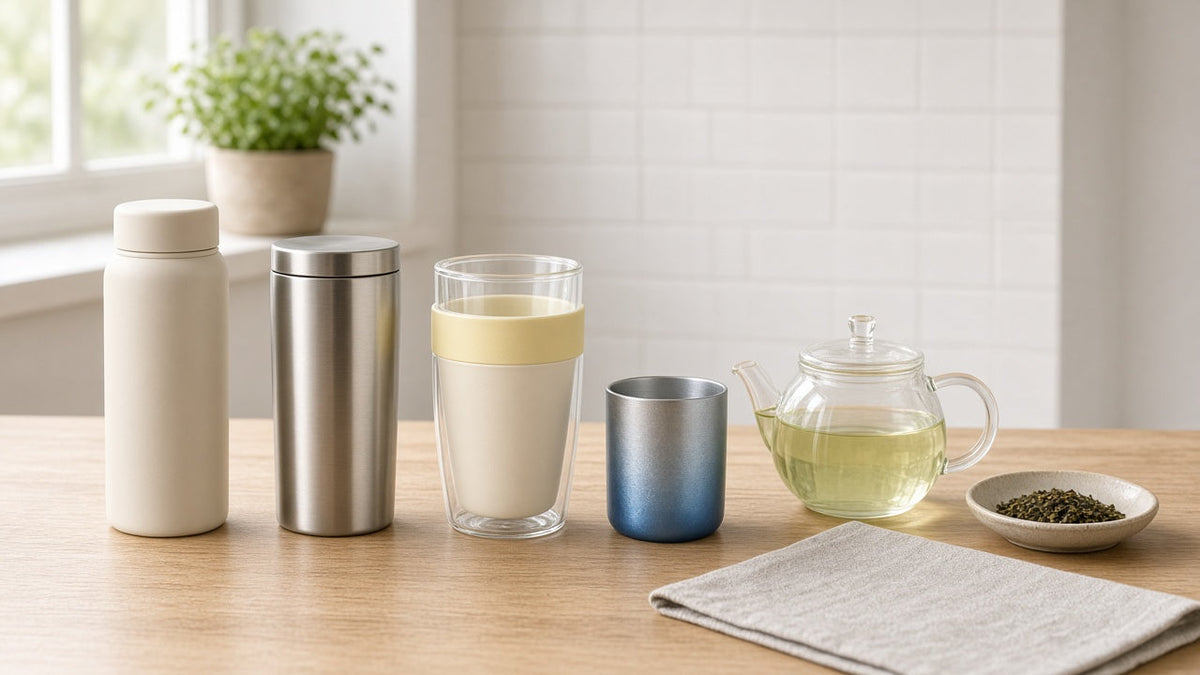
Make a pot of jasmine tea in the morning, pour half into a bare steel tumbler and half into a glass, and taste both at lunch. Some people can't tell them apart. Others swear the steel one tastes faintly of a spoon. That small gap is most of the ceramic lined tumbler vs stainless steel debate. On the outside the two are built alike, a vacuum-insulated steel body that holds temperature. The difference is the thin surface your drink actually touches. Ceramic lining buys you a neutral taste and asks for gentler care. Bare stainless steel gives up a little taste neutrality and can take almost any abuse. Below we compare the two, bring titanium and glass into it, sort out what 304, 316 and 201 steel mean, and match each material to the drinks you actually carry.
The short version
- Ceramic lining changes taste and care, not insulation. In both tumblers the vacuum wall does the insulating.
- Food-grade stainless steel (304 or 316) is considered safe for water and tea. Most metal release happens in a new vessel, with acidic drinks and long contact.
- Reach for ceramic or glass if you carry lemon water, juice or fruit tea, or if steel tastes metallic to you. Keep bare steel for hard daily use.
- Titanium is light and tastes of nothing, but a double-wall titanium cup with an air gap won't hold heat the way a vacuum tumbler does.
What part of a tumbler actually touches your drink?
Before comparing materials, take your tumbler apart on the counter and sort the pieces into two piles. In the first pile goes everything your drink touches: the inner wall, the lid and spout, the silicone gasket, the straw. In the second goes everything it doesn't: the outer shell and the little sealed spot under the base. Safety and taste are decided almost entirely by the first pile.
That sounds obvious, but listings don't always read that way. Plenty of them lead with the outside steel, and a cheaper grade outside with a better grade inside is a normal, sensible build. And whatever the cup is made of, the lid is almost always PP plastic with silicone seals, so the "all-steel" or "all-ceramic" sip isn't quite real.
| Part | Typical material | Touches the drink? |
|---|---|---|
| Inner wall | 304 or 316 stainless steel, a ceramic coating, titanium or glass | Yes, all the time |
| Lid and spout | PP plastic | Yes, every sip |
| Gasket and seals | Silicone | Yes, around the rim |
| Straw | PP, glass or steel | Yes |
| Outer shell | 201 or 304 stainless steel | No |
| Vacuum seal under the base | Solder pellet under a steel cap | No, unless the cap comes off |
Is stainless steel safe to drink from?
For water and tea, yes. Germany's Federal Institute for Risk Assessment (BfR) calls stainless steel well suited for food contact. It points out that metals can in principle migrate from any metal container, then says it is unaware of any general problems with stainless steel products.
The research is more interesting than the reassurance, because it shows when migration goes up. A 2021 study from Sapienza University filled 20 best-selling reusable bottles (twelve aluminum, one stainless steel, the rest plastic and silicone) with deionized water every day for four weeks. Most elements came out in the first 24 hours. In the bottle that released the most nickel, the nickel stopped after day one. Even the highest nickel reading across all the bottles stayed at about 71% of the EU drinking-water limit; chromium peaked at about 6%. Compare that with a 2013 cooking study: after six hours of simmering in stainless steel, nickel levels in tomato sauce rose as much as 26-fold, and brand-new steel leached the most.
Put those together and you get three habits worth keeping. Wash a new tumbler in warm soapy water, brush it out, and rinse it a couple of times before the first real fill. Don't park acidic drinks in bare steel from breakfast to dinner. And if lemon water or juice is your daily drink, give it a lined or glass vessel.
304 vs 316 stainless steel tumbler: does the grade matter?
A little, and less than the marketing suggests. 304 is the workhorse of food equipment, roughly 18% chromium and 8% nickel, which is why you also see it sold as 18/8. 316 adds molybdenum and a bit more nickel, and the molybdenum is what helps it resist pitting from salt and chlorides. A peer-reviewed review in Food Protection Trends calls 316 generally the higher grade for food contact surfaces, and says 200-series steels are generally not recommended for food equipment.
For plain water and tea you won't taste a difference between 304 and 316. We'd lean toward 316 if you add electrolyte powder or salt to your water, or wash with chlorine-based cleaners. The more useful habit is checking which part each grade is used for. Our Stainless Steel Travel Mug 550 mL is a good example: its listing names a 201 outer shell, a 304 inner wall and a 316 inner base. The 201 is the outside skin your hand holds; it never meets the drink.
Ceramic lined tumbler vs stainless steel: what changes?
Taste is the usual reason people switch. A ceramic coating puts a smooth, glassy surface between the drink and the steel, and for many people the faint metallic edge in green tea or cucumber water goes with it. If you've never noticed that edge, you probably won't notice much change.
Insulation doesn't change, because neither the steel nor the ceramic is doing the insulating. The vacuum between the walls is. What does change is how you treat it. You can scrub bare steel with a bottle brush, knock it off a desk and keep going. A coating is tougher than it looks, but a hard drop onto tile or a pass with steel wool can chip it. Our Ceramic-Coated Insulated Tumbler 735 mL puts a ceramic coating over a 316 stainless steel inner wall, and its care notes are clear: hand wash, no abrasive cleaners or steel wool, no microwave, no dishwasher.
| Material | Taste | Durability | Holding temperature | Care | Best for |
|---|---|---|---|---|---|
| Bare stainless steel (304/316) | Neutral for most people; some notice a metallic edge | Very high | Excellent with a vacuum wall | Easiest; brushes are fine | Water, iced water, rough daily use |
| Ceramic-coated steel | Very neutral | Coating can chip under hard knocks | Same as steel (vacuum wall) | Hand wash, soft sponge, no abrasives | Tea, flavored and acidic drinks |
| Titanium | Very neutral | Very high, and light | Low unless vacuum-insulated | Hand wash; never heat a double-wall cup | Drinks finished in one sitting |
| Borosilicate glass insert | The most neutral | Glass can break | Good when nested in a vacuum steel cup | Hand wash, handle with care | Taste purists, switching between drinks |
Are ceramic lined tumblers safe?
An intact, food-grade ceramic lining is a stable surface to drink from, and for acidic drinks it's arguably a better one than bare steel. The useful questions are about the coating, not ceramic in general. In insulated tumblers, "ceramic lined" almost always means a coating bonded to the steel wall, not a separate ceramic cup tucked inside. So ask what metal sits underneath, and whether the lining is rated for food contact. If a listing can't tell you either, that tells you something.
Checking your own is easy. Shine a phone torch inside and look along the bottom edge, where the wall meets the base; that corner takes the most knocks from spoons, ice and brushes. Then run a fingertip around it. The coating should feel uniformly smooth. A rough spot, a dull patch or a sharp edge is worth a closer look.
Chips are the other worry. A small chip means your drink touches the steel underneath at that spot, which is no worse than drinking from a steel tumbler as long as that steel is food-grade. Flaking is different. If the coating is lifting or peeling, retire the tumbler. BfR's checklist for bottles says the same thing in plainer words: dispose of it if there is significant damage to the inside.
Why does my water bottle taste like metal?
Usually it's one of five things, and the cup itself isn't always to blame. The first is a brand-new bottle, which lines up with the research above: release is highest in the first day, so a proper wash and a couple of rinses before first use help. The second, and the one people overlook most, is the lid. Old residue in a gasket groove tastes stale and metallic, and people blame the cup. Third come acidic drinks or tea left in bare steel for hours. One r/tea user on Reddit put it plainly: tea "seems to go bad pretty fast with a metallic taste" in their steel tumblers. Fourth, your lips are touching a bare steel rim, which some people simply taste. Fifth, the water itself is mineral-heavy.
Work through the fixes in that order. Pull the gasket out (a blunt butter knife or a toothpick gets under it without tearing it) and wash every part. For a lingering taste, Klean Kanteen's advice is a diluted vinegar soak overnight for the cup and cap; rinse well and let everything dry with the lid off. If tea still tastes wrong after a clean tumbler and fresh water, the liner is the answer, and that's where ceramic or glass earns its place. Our Insulated Tumbler with Removable Glass Insert 900 mL lets you drink from borosilicate glass while a vacuum-insulated steel cup does the insulating. For the full cleaning routine, our guide on how to clean a stainless steel tumbler covers gaskets, straws and stains step by step.
Titanium vs stainless steel tumbler: is it worth it?
Titanium's reputation is mostly deserved. It forms a thin, stable oxide film that resists corrosion, which is a big part of why it's trusted for medical implants. In a cup that means a very neutral taste and very little weight in your hand. What titanium doesn't do by itself is insulate. That still comes down to construction.
Our Double-Wall Titanium Cup 320 mL is a good illustration. It has two titanium walls with an air gap between them, not a vacuum, so it slows heat transfer enough for a cup of tea you'll finish at your desk, not one you'll still be sipping at four o'clock. The listing is also firm that it must never go in a microwave, on a stove or over a flame, and its lid is splash-resistant, not leakproof. So titanium is worth it if taste and lightness matter most. If you want a drink to stay hot all afternoon, a vacuum steel tumbler, lined or not, will do better for less money.
Glass vs stainless steel water bottle
Glass is the most neutral thing you can drink from. Both BfR and Clemson Extension describe it as chemically stable or inert, and nothing about it changes the taste of water. The catch is the obvious one: it breaks. Borosilicate glass, the type used in lab glassware, copes with temperature changes far better than ordinary glass because boron gives it very low thermal expansion, as Corning explains. It is still glass, though, and still breaks if you drop it on tile.
That's why glass-insert tumblers are such a neat compromise. You sip from glass while a steel cup takes the knocks and the vacuum does the insulating. With our 900 mL model you can use the glass in the steel cup, the steel cup alone, or the glass on its own. One detail from its listing is worth copying for any tumbler: with hot drinks, let them cool a little and sip from the rim instead of the straw.
Which material is safest for each drink?
Every material here is safe when it's food-grade and in good condition, so the better question is which one suits the drink you carry most. This is how we'd match them:
| Drink | Best choice | Fine | Avoid |
|---|---|---|---|
| Plain or iced water | Any food-grade liner | Bare 304 or 316 steel | Linings that are flaking |
| Hot tea | Ceramic-coated or glass | 316 steel, emptied the same day | Sipping hot tea through a straw |
| Lemon water, juice, fruit tea | Glass or ceramic-coated | Steel for a few hours | Bare steel all day, every day |
| Sparkling water | Glass or ceramic-coated | Steel for short periods | Long storage in bare steel |
| Electrolyte or salty drinks | 316 steel, ceramic or glass | 304 steel, rinsed soon after | Leaving it to sit for days |
If you heat water for tea at the office or in a hotel room, our travel kettle buying guide compares small kettles by power source, capacity and temperature presets.
Is there lead in insulated tumblers?
This came up a lot after early 2024, so this is what's actually going on. To seal the vacuum between the two walls, many factories melt a small solder pellet into a spot on the base, then cover it with a steel cap. In some brands that pellet contains lead. WIRED reported that several big names confirmed using it while others use lead-free sealing. The pellet sits outside the drinking chamber, so it doesn't touch your drink. The real risk is a base cap that falls off after a drop. If yours does, stop using the tumbler and contact the maker. And if a lead-free seal matters to you, ask the brand before you buy.
Care mistakes that damage any liner
More tumblers are ruined by cleaning than by drinking. Steel wool and scouring powder are the big one for ceramic coatings; a soft sponge and a bottle brush with soft bristles do the job. The dishwasher is next. Every tumbler mentioned here says hand wash on its listing, and Clemson Extension warns that the dishwasher can damage an insulated bottle's insulation. Microwaving or heating a double-wall cup is a hard no. Storing a damp tumbler with the lid screwed on is how a fresh cup starts to smell sour. Bleach on brushed steel is another; the care notes for the 550 mL stainless model above rule it out. And with glass, the one we'd underline is pouring boiling water into a glass insert straight from the fridge. Let it warm up on the counter first.
Recommended for you
Not everyone needs a ceramic liner. If your routine looks different, one of these may suit it better.

For a light, neutral cup
Double-Wall Titanium Cup 320 mL
Pure titanium inner and outer walls with an air gap, and a clear sip lid. Made for drinks you finish in one sitting; never heat it. $39.99.
View product
For loose-leaf tea in 316 steel
Stainless Steel Travel Tumbler 750 mL with Tea Filter
SUS316 stainless steel interior, a removable slotted tea filter and a lid with both a straw spout and a direct-sip opening. Hand wash. $39.99.
View product
For everyday water
Stainless Steel Travel Mug 550 mL
A 304 stainless steel inner wall and 316 inner base inside a 201 steel outer shell, with a dual-sip lid and fold-away handle. $29.99.
View productCeramic lined tumbler vs stainless steel FAQ
Is a ceramic lined tumbler better than stainless steel?
For taste, usually yes, especially with tea and acidic drinks. For durability and easy cleaning, bare stainless steel wins. Insulation is the same in both, because the vacuum between the walls does that job.
Are ceramic lined tumblers safe?
Yes, when the lining is food-grade and intact. In tumblers it's a coating bonded to the steel, so check what metal sits underneath. A small chip exposes that steel; if the coating flakes or peels, replace the tumbler.
Is 316 stainless steel better than 304 for a tumbler?
316 resists corrosion from salt and chlorides better because it contains molybdenum. For plain water and tea, both are food-grade and you won't taste a difference. 316 makes more sense if you add electrolytes or salt.
Why does water taste like metal in my tumbler?
Most often it's a new tumbler that needs a proper wash, residue in the lid gasket, an acidic drink or tea left in bare steel for hours, or mineral-heavy water. Wash every part, soak the cup and cap in diluted vinegar overnight, rinse and dry with the lid off. If it persists, try a ceramic or glass liner.
Is titanium safer than stainless steel to drink from?
Both are safe for drinks. Titanium resists corrosion even better and tastes very neutral, but it costs more, and a double-wall titanium cup with an air gap does not hold heat the way a vacuum-insulated tumbler does.
Can you put lemon water or juice in a stainless steel tumbler?
Yes, for a few hours. Studies show acidic contents and long contact increase metal release from steel, so for all-day lemon water or juice we'd use a glass or ceramic-coated tumbler.
Can I put a ceramic lined tumbler in the dishwasher?
Check the listing. Many, including ours, say hand wash only. Use warm soapy water and a soft sponge, and keep steel wool and scouring powder away from the coating.
Think about the drink you carry most days, then pick the liner that suits it. All our tumblers are in one place, with the inner material listed on every page.
Browse Drinkware & Travel MugsSources
- German Federal Institute for Risk Assessment (BfR), BfR2GO 1/2026: Drinking bottles, stainless steel well suited for food contact, glass chemically stable, dispose of bottles with significant damage inside.
- Astolfi et al., Reusable Water Bottles: Release of Inorganic Elements, Phthalates, and Bisphenol A in a "Real Use" Simulation Experiment, Separations, 2021, 20 bottles, release highest in the first 24 hours, maximum nickel 71% and chromium about 6% of drinking-water limits.
- Kamerud, Hobbie and Anderson, Stainless Steel Leaches Nickel and Chromium into Foods During Cooking, Journal of Agricultural and Food Chemistry, 2013, tomato sauce, up to 26-fold nickel after 6 hours, new steel leached most.
- Schmidt et al., Characteristics of Food Contact Surface Materials: Stainless Steel, Food Protection Trends, October 2012, 304 at 18% chromium and 8% nickel, 316 the higher grade for food contact, 200 series not recommended for food equipment.
- Institute of Corrosion, Ask the Expert, 316 adds molybdenum for resistance to localized corrosion.
- Corning, Boron: advantages of boron in borosilicate glass, low thermal expansion, withstands faster temperature changes than soda-lime glass.
- Hanawa, Biocompatibility of titanium from the viewpoint of its surface, Science and Technology of Advanced Materials, 2022, passive oxide film and corrosion resistance.
- WIRED, Is There Lead in Your Reusable Water Bottle?, February 2024, lead-containing sealing pellet under the base cap, brands with lead-free sealing.
- Klean Kanteen, Care and Use, diluted vinegar soak overnight for bottles and caps that retain flavors.
- Clemson Cooperative Extension HGIC, The Scoop on Reusable Water Bottles, glass inert, stainless steel non-reactive, daily washing.
- Reddit r/tea, Ceramic lined stainless double insulated tea drinkware?, a user's metallic taste with tea in steel tumblers.
Youlva product details were checked against current listings on November 6, 2026.