
How to Cook Eggs in a Titanium Pan Without Sticking: Heat, Fat & Fixes
November 13, 2026
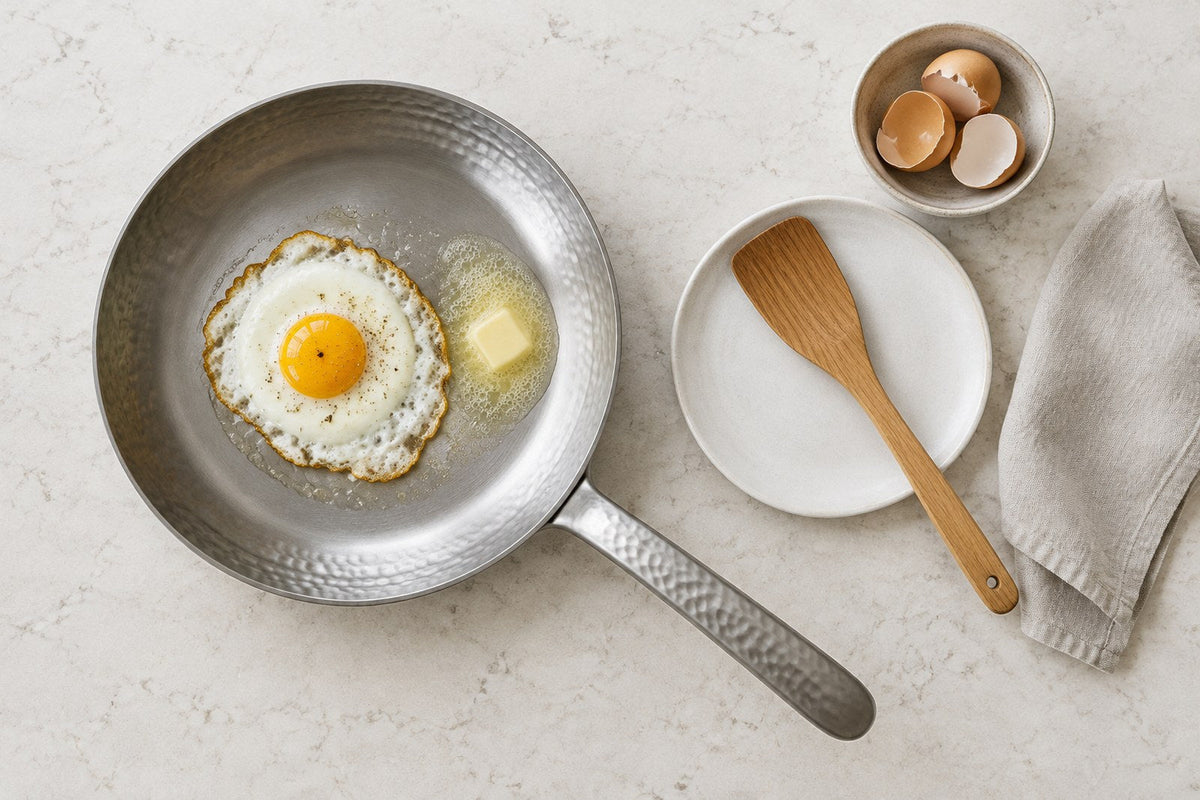
The pan looks great, the egg goes in, and ten seconds later the white has welded itself to the metal. You scrape, you mutter, you wonder if the pan is faulty. Usually it is not. How to cook eggs in a titanium pan comes down to a properly preheated surface, a teaspoon of fat and moderate heat. Titanium is bare metal, so it will not forgive a cold start the way a PTFE non-stick pan does, and eggs are where you find that out first.
The short version
- Preheat the empty pan on medium for about 2 to 4 minutes. Flick in a few water drops: when they bead up and skate around, the pan is ready.
- Add a little oil or butter, drop to medium-low, put the egg in and leave it alone until the white is set.
- Let eggs sit out for about 15 minutes first. Fridge-cold eggs chill the surface and cling harder.
- Cook fried and scrambled eggs until firm, as the FDA advises, and check egg dishes such as frittata to 160°F.
Why do eggs stick to a titanium pan?
Egg white is mostly protein, and protein grabs bare metal as it sets. A coated pan hides that behind a slick layer. The Youlva pure titanium hammered frying pan has no such layer: the listing describes an uncoated titanium surface. So the technique has to do the job the coating would have done.
Heat behaviour plays a part as well. The Engineering ToolBox puts titanium at about 22 W/m·K, against roughly 236 for aluminium and 14 for 304 stainless steel. Titanium is a mediocre heat spreader. The listing describes pure titanium and says nothing about a bonded aluminium core, so expect the area over the flame to run hotter than the rim. Centre the pan on the burner and give it that extra minute, or you will get one hot patch and one cold one.
How hot should the pan be? The water-drop test
America's Test Kitchen explains that above roughly 365 to 379°F a thin cushion of steam lifts food off hot metal, which is the Leidenfrost effect. You do not need a thermometer to find that point. Put the empty pan on medium for 2 to 4 minutes, then flick a few drops of water onto it. Drops that sit and sizzle mean the pan is still cold. Drops that vanish on contact mean it is too hot, so turn it down and wait. Drops that roll around like little beads mean you are in range.
One catch from Serious Eats: water beads even on an overheating pan, so once you see it, cook straight away rather than wandering off to find the butter.
How to fry an egg in a titanium pan, step by step
This is the routine I would hand to anyone with a new pan. It takes about five minutes, most of it waiting.
- Take the egg out of the fridge about 15 minutes ahead. Serious Eats makes the point that a cold egg shocks the pan surface.
- Preheat the empty pan on medium for 2 to 4 minutes and run the water-drop test.
- Add about a teaspoon of oil or butter and tilt the pan so it coats the base. It should shimmer, not smoke.
- Turn the burner down to medium-low, then crack the egg in. The pan already holds plenty of heat.
- Hands off until the white is opaque and the edges look firm. Run a thin spatula along the edge, and on a hammered surface go slowly, because the dimples hold on to a bit of white. If it clings, give it another 15 to 30 seconds instead of forcing it.
- For over easy, flip and give it 20 to 30 seconds. The FDA wants both yolk and white firm, so go longer if that matters to you.
Most torn eggs are not a pan problem. Someone got impatient. A set egg lets go by itself; a half-set one never will, and I would rather you lose a minute waiting than ten scrubbing.
How do you scramble eggs or make an omelette without sticking?
The preheat stays the same, but the heat afterwards goes lower than you think. Pour in the beaten eggs, let a thin layer set at the bottom, then push it gently with a silicone or wooden spatula so it folds into soft curds. The FDA says scrambled eggs should not be runny, so pull the pan off only when they look just set, since residual heat keeps cooking them.
For an omelette, tilt the pan so the egg spreads thin, wait for the bottom to set, then fold. Anything bigger, like a frittata, deserves a thermometer. FoodSafety.gov lists 160°F (71°C) for egg dishes.
Which fat should you use, and how much?
Butter tastes better but browns fast, so it suits a pan you already have under control. A neutral oil gives you more margin while you are learning how your burner behaves. A teaspoon covers a single egg. Pouring in more does not make the surface slicker, it just leaves the egg frying in a puddle. If the fat smokes the second it hits the pan, the pan is too hot. Lift it off the burner for a few seconds, wipe out the burnt fat and start the swirl again. Doing a second batch? The pan is already hot, so lower the burner a notch before the next egg.
Why is my egg still sticking?
Work down this list before blaming the pan.
| What you see | Most likely cause | What to change |
|---|---|---|
| White welds on and tears | Egg went into a cold pan | Preheat 2 to 4 minutes and run the water-drop test |
| Brown, crisp edges, undercooked yolk | Heat too high | Drop to medium-low once the egg is in |
| Egg tears when you flip it | Moved too early | Wait until the white is fully set, then add 15 to 30 seconds |
| Pale, rubbery egg that grips | Pan was too cool | Preheat longer before adding fat |
| Sticks on one side only | Pan sitting off-centre or uneven heat | Centre it on the burner and rotate it halfway |
How do you clean a titanium pan after eggs?
Let it cool first, which is what the listing asks for. Then fill it with warm water for a few minutes and a soft sponge will lift whatever is left. Skip the cold-water blast on a hot pan. The listing says the pan suits induction and gas, but it does not say it is dishwasher safe, so check the warranty notes before you run it through one. On induction, I would start a notch lower than you would on gas and watch the first egg.
Recommended for you

When you want boiled eggs
Electric Egg Cooker
Six eggs, one-touch control and no pot to watch. See our egg cooker guide. From $39.99.
View product
To season at the stove
Electric Salt & Pepper Grinder
USB-C rechargeable, 5 grind settings, one hand free for the spatula. See our grinder guide. From $49.99.
View productTitanium pan eggs FAQ
Why do my eggs stick to a titanium pan?
Usually the pan was cold, the heat was too high, or you moved the egg before the white set. Titanium is uncoated, so preheat, a little fat and patience do the job a coating would.
Is a titanium pan non-stick?
Not in the PTFE sense. The listing describes an uncoated titanium surface, so treat it like a good metal pan and let food release on its own.
Do I need oil or butter?
Yes, about a teaspoon for one egg, added after the pan has preheated.
Can I use a titanium pan on induction?
The Youlva listing says induction and gas both work. Start a little lower than you would on gas, since the pan heats where the base touches the field.
What heat do I use for scrambled eggs?
Preheat on medium, then cook on medium-low. Stir gently and pull the pan off just before the eggs look done, because they keep cooking.
How do I know when the pan is hot enough?
Flick a few drops of water in. If they bead up and roll around, go. If they sit and sizzle, wait another 30 seconds and test again.
Tomorrow morning: preheat for three minutes, flick the water, one teaspoon of butter, medium-low, and do not touch the egg for a full minute. The pan and the tools for it are in the cooking and food prep range.
Browse cooking & food prepSources
- America's Test Kitchen, How to Make Stainless Steel Nonstick, the Leidenfrost water-drop test, the 365 to 379°F range and why food added too early sticks.
- Serious Eats, Stainless steel skillet egg method, resting eggs about 15 minutes, preheating about 3 minutes on medium, letting set whites release on their own.
- The Engineering ToolBox, Thermal conductivity of metals and alloys, titanium about 22 W/m·K at 0°C against about 236 for aluminium and about 14 for 304 stainless steel.
- FDA, What you need to know about egg safety, cook eggs until yolk and white are firm; egg dishes to 160°F.
- FoodSafety.gov, Safe minimum internal temperatures, eggs cooked until firm; egg dishes such as frittata and quiche at 160°F (71°C).
Specs and prices checked on the product listings 2026-11-13 (Asia/Shanghai). Always follow the care notes that came with your own pan.