
How to Make a Smoothie in a Portable Blender: Order, Ratios & Fixes
November 09, 2026
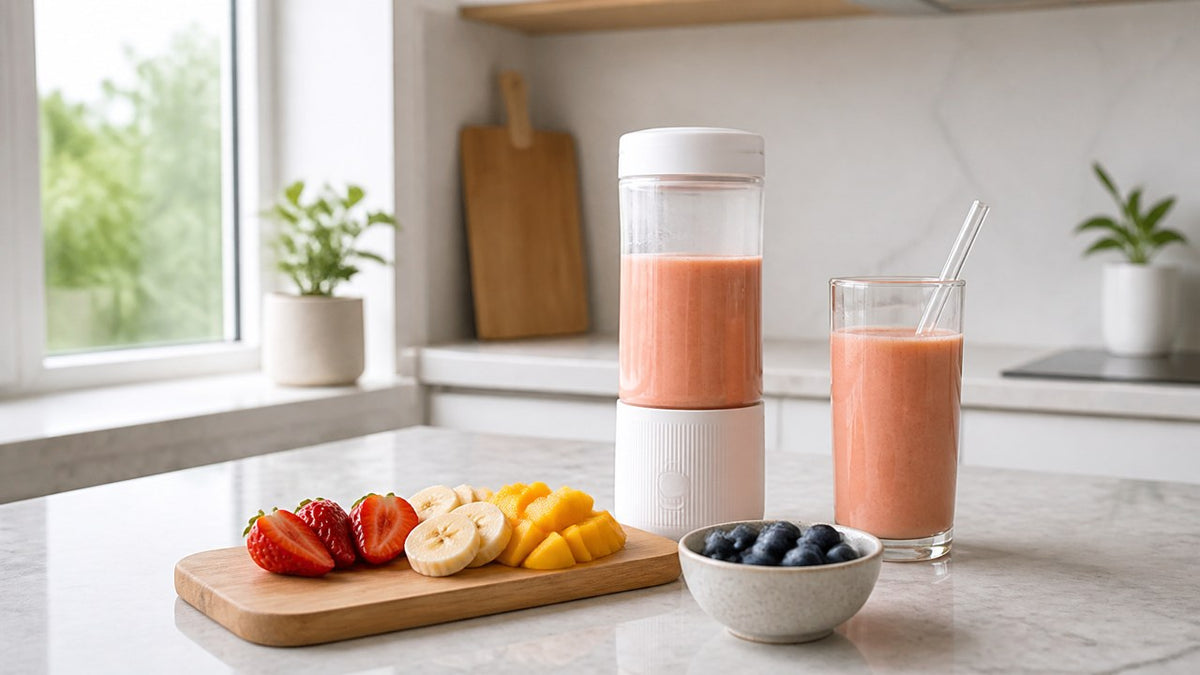
Monday morning, one cup, a banana, frozen mango and a big spoon of yogurt. I pressed start and got a sad whirr: the blades were spinning in an air pocket under a frozen brick. That is the first thing to get right if you want to know how to make a smoothie in a portable blender. A small cup punishes sloppy loading. Cut the fruit small, fill it about two-thirds, get the liquid where the blades can reach it, and 35 seconds of blending is enough.
The short version
- Fill level: about two-thirds full at most. Cup capacity is not a recommended fill.
- Order depends on the blades: if the cup flips over before blending, frozen pieces go in first and liquid last. If the blades sit in the cup, liquid goes in first.
- Starter ratio: roughly 1 part liquid to 2 parts frozen fruit, plus a spoonful of yogurt if you like it thick. Add the liquid gradually.
- If it stalls: stop, add a splash of liquid, loosen the contents and restart. Mashing the button won’t help.
Ingredient order in a portable blender: it depends on the blades
Most smoothie articles say liquid first, frozen fruit last. That works for a pitcher blender, where the blades sit in the base. Portable blenders come in two layouts, and the order flips between them. Good Housekeeping’s test kitchen puts it plainly: if the blender has to be turned upside down onto the motor, reverse the layering. The softest ingredients should sit around the blades and the hardest on top.
Our 450 mL dual-lid blender has its 12-blade assembly inside the motor lid, and the 800 mL cup’s listing spells it out: secure the lid, then invert the closed cup so the ingredients reach the blades. On those you fill the cup first and flip it, so the last thing in ends up nearest the blades. The 500 mL carry-handle blender uses a motor base with its own blade assembly, and the manual shows how the cup sits. Read that page once, work out where the blades land, then use the table below.
| Where the blades end up | Build the cup in this order | Why |
|---|---|---|
| Cup is filled, then flipped onto the blades | Frozen or hard pieces, then greens and powders, then soft fruit and yogurt, then liquid last | Liquid and soft food land around the blades when you flip it |
| Blades sit in the cup base, you fill upright | Liquid first, then powders, yogurt and soft fruit, greens, then small frozen pieces | Liquid reaches the blades first and the frozen pieces feed down into it |
Wirecutter’s pitcher-style order runs liquids first, then wet and dry ingredients, then greens, fruit and finally ice and frozen things. Whatever the layout, the blades need liquid around them to start a vortex.
A smoothie ratio that fits a small cup
Good Housekeeping’s test kitchen uses half to one part liquid, half a part yogurt, and one and a half to two parts frozen fruit or vegetables. Skip the yogurt and add more liquid. They also say outright that you may need to halve a favorite recipe for a personal or portable cup, so there is room for a vortex to form. That matches what I see. A recipe built for a 1.5 L jar will not fit in 450 mL, and I would rather buy a bigger cup than cram a small one.
Add liquid a little at a time. Purple Wave’s portable blender guide makes the same point: if the mixture barely moves, add a splash. Thinning a smoothie is easy, and rescuing an over-diluted one is not.
| Cup | About two-thirds full | Notes |
|---|---|---|
| 400 mL glass | about 260 mL of food and drink | Stay under the MAX line on the cup |
| 450 mL | about 300 mL | One ~40 s cycle |
| 500 mL | about 330 mL | P2 smoothie preset runs 35 s |
| 630 mL | about 420 mL | Wait for the blades to stop before opening the flip lid |
| 800 mL | about 530 mL | Leave room for the blending lid and blade assembly |
The two-thirds figure is my own rule of thumb, not a manufacturer spec. Product pages say to leave headroom and follow the manual. If a recipe won’t fit, step up to a bigger cup.
Four smoothie recipes sized for a portable blender
These are sized for a 450 to 500 mL cup. Cut everything small, load it for your blender’s layout (table above), and stop at about two-thirds full.
Banana berry
Half a banana in thick slices, about a third of a cup (50 g) of frozen berries, a quarter cup (60 g) of plain yogurt and a third of a cup (80 mL) of milk. It is the forgiving one, and the recipe I use to test a new blender.
Mango yogurt
Half a cup of mango chunks that have sat out for five minutes, a third of a cup (80 g) of yogurt and about 100 mL of orange juice. Partly thawed mango blends far more easily than a hard frozen cube.
Green and tropical
A small handful of baby spinach (about 20 g), half a banana, a third of a cup of pineapple pieces and 120 mL of coconut water or plain water. Put the spinach right next to the liquid so the blades catch it early.
Chocolate peanut butter shake
200 mL of milk, one scoop of protein powder or two teaspoons of cocoa, half a banana and a tablespoon of peanut butter. Add the powder after the liquid so it doesn’t cake around the blades, and rinse the cup straight away.
Frozen fruit and ice: what a small cup can handle
Frozen fruit works when the pieces are small and there is liquid to move them. Blendit’s portable-blender guides list the same three mistakes: large frozen pieces, too little liquid, and an overfilled cup. Ice is a different story. The 500 mL model has a dedicated 40-second ice preset, and the listing says to follow the manual for quantity. The long answer is in Can a Portable Blender Crush Ice?.
Don’t tip in a fistful of big cubes and press start. The blades spin in an empty cave while the cubes sit above them. I stick to small frozen pieces and the smoothie preset.
My blending routine, step by step
- Charge the blender over USB-C first. A half-empty battery gives up on a thick mix.
- Cut fruit small, and let big frozen chunks soften for a few minutes.
- Load the cup for your blender’s layout, up to about two-thirds full.
- Seat the lid or cup properly. Models with a safety lock won’t start otherwise.
- Run the smoothie preset or auto cycle, and wait for the blades to stop completely before you open anything.
- Chunks left? Loosen the contents, add a splash of liquid and run it once more.
When it comes out chunky, stuck or watery
It hums but nothing moves. The blades are sitting in an air pocket. Stop, add a splash of liquid, loosen the mix and try again. Purple Wave recommends stopping and resetting rather than forcing a dense mixture. If the unit won’t start at all, our portable blender not working fixes cover power, lights and charging.
Chunks of fruit left. The pieces were too big or the cup was too full, and usually there is one half-frozen strawberry parked right over the blades. Cut smaller next time and drop the volume.
Too thin. The liquid went in too fast. Next time pour it gradually and add frozen fruit or a spoon of yogurt for body.
Powder clumps. The powder got buried under dry food and never met the liquid. Keep it right beside it.
Picking a size is a separate decision, and the portable blender buying guide compares capacity and battery.
Rinse it before you sit down
Smoothie sets on the blades fast, and chipping off dried banana is a lousy way to start the day. Rinse the cup as soon as you finish. The 500 mL model has a 15-second cleaning preset, and on the 800 mL you add water, secure the lid and run it briefly. Never put the motor lid or base under water. The full routine is in how to clean a portable blender.
Tomorrow, pour the liquid in last on a flip-style blender and see whether the smoothie blends in one go.
Other cup sizes worth a look

Bigger servings
Portable Blender 800 mL, 80 W
80 W motor in the lid, clear 800 mL cup, single or two-cup kit. $39.99.
View product
Display and strap
Portable Blender 630 mL, LED Display
Clear 630 mL cup, two-button panel, 1300 mAh USB-C battery, flip-top lid. $39.99.
View product
Glass cup
Portable Glass Blender 400 mL
Borosilicate glass cup with a MAX line, six stainless blades, USB-C. $49.99.
View productPortable blender smoothie questions
What order do you put ingredients in a portable blender?
Picture where the blades will be when it runs. The softest ingredients and the liquid should end up closest to them. If your blender runs upside down after you fill the cup, as the 800 mL motor-lid cup does, load in reverse: frozen and hard pieces first, then powders, soft fruit and finally liquid. If the blades sit in the cup, liquid goes in first and the frozen fruit on top.
How full should a portable blender be?
Well below the cup's capacity. Capacity is the volume of the cup, not a recommended fill. The 400 mL glass cup has a MAX line, and I keep every blender at about two-thirds full so the contents can circulate. For bigger servings, buy a bigger cup instead of packing a small one.
Can I put frozen fruit in a portable blender?
Yes, in small pieces and with enough liquid. Let large frozen chunks sit for a few minutes first, and add more liquid than feels necessary on the first try. A solid frozen block over the blades is the most common reason a portable blender stalls.
Why won't my portable blender blend the smoothie?
Usually the blades are spinning in an air pocket above a packed mass. Stop, add a splash of liquid, shake or tilt the cup to loosen things, and run it again. Don't keep pressing start on a jammed mix. If it won't start at all, check that the lid or cup is fully seated; the safety lock cuts the motor when it isn't.
How long should I blend a smoothie in a portable blender?
Follow your model's cycle. The 450 mL blender runs an automatic cycle of about 40 seconds. The 500 mL has presets: 30 seconds for fruit, 35 for smoothie and 40 for ice. If the first cycle leaves chunks, loosen the contents and run another.
Can I make a protein shake in a portable blender?
Yes. Load it for your blender's layout and keep the powder next to the liquid so it doesn't cake around the blades under dry food. Blend in short bursts if it clumps, and rinse right away.
Do I need to clean the blender right after I drink?
Yes, rinse as soon as you finish, because smoothie residue dries hard around the blades. On the 500 mL you can run the 15-second cleaning preset with a little water, and the 800 mL can be rinsed by blending water briefly. Wait for the blades to stop fully before you open it.
Cut the fruit small, fill to two-thirds, and see what a 35-second blend does.
Browse portable blendersSources
- Good Housekeeping — Top-Tested Smoothie Blending Tips, layering order, portable blender note and smoothie ratio.
- Purple Wave — How to Use a Portable Blender, liquid first, cut small, fill room, stop and add liquid.
- Blendit — Portable Blender Recipes, ingredient order and common recipe mistakes.
- Wirecutter — The Order You Load Your Ingredients Can Make or Break a Smoothie, load order for pitcher blenders.
Specs checked on product listings 2026-11-09 (Asia/Shanghai). Fill levels and recipes are starting points; follow your blender manual.