
Can a Portable Blender Crush Ice? How to Blend Ice & Frozen Fruit
October 20, 2026
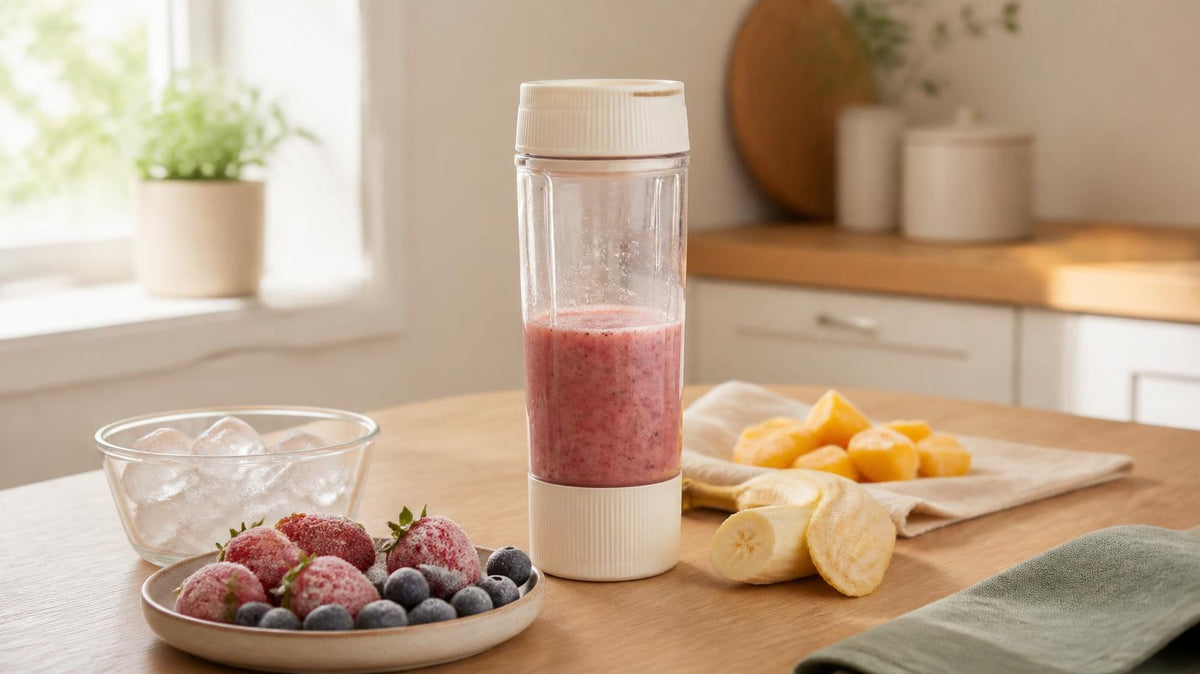
Every summer a customer emails me some version of the same message. They filled their new blender cup with frozen strawberries and a few cubes from the freezer tray, pressed the button, and listened to the motor scream while the fruit sat there like a paperweight. So can a portable blender crush ice? Some can, if you keep the ice small and give the blades liquid to work in. Whole tray cubes beat most battery blenders. Frozen fruit is a different story, and once you load the cup the right way it blends smooth almost every time.
The short version
- Most battery blenders can't fully crush whole tray cubes. In WIRED's cordless test, only one model crushed ice without a running start.
- Liquid has to sit against the blades when you press start: in first for cups with blades in the base, in last for cups you flip upside down.
- Keep frozen ingredients to about a third of the cup. Vitamix's ceiling is 30%, and that's for a full-power machine.
- Use crushed ice or small cubes, with liquid, in a blender that has an ice setting, like the 40-second P3 mode on our 500 mL model.
Can a portable blender crush ice? What the tests show
The reviewers who've tested these side by side are fairly blunt about it. When WIRED ran its cordless blender round-up, the Ninja Blast Max was the only one that could crush ice without a running start. Serious Eats found most personal blenders had trouble with ice because the blades are small and the jars are narrow, so chunks have nowhere to tumble. Popular Science liked the Nutribullet Flip with frozen ingredients, yet even that one didn't fully pulverize full-sized cubes.
It mostly comes down to power. WIRED points out that most cordless blenders top out at double-digit watts, while the countertop Nutribullet Ultra it recommends is a 1,200-watt machine. The portable blenders we sell are rated between 25 W and 80 W. That's more than enough for soft fruit, yogurt or a scoop of protein powder. Ice asks for a lot more.
The brands hedge as well, if you read the small print. Nutribullet says its Portable Blender can crush ice as part of a smoothie but shouldn't be used as an ice crusher on its own, and it wants enough liquid in the cup. BlendJet's advice lines up: blend ice only with plenty of liquid, and don't use big cubes.
Why portable blenders stall on ice and frozen fruit
Torque is the first problem. A small battery motor spins very fast in an empty cup and slows sharply once it meets something hard. Our 500 mL model is a good example: it's rated at 21,000 rpm without a load and 12,000 rpm under one.
Then there's the air pocket. Frozen pieces wedge together just above the blades, the blades carve out a little hollow, and from then on they're spinning in air. Vitamix calls this cavitation and says the usual fix for a stalled blend is a bit more liquid. Philips adds that frozen fruit is stickier than other ingredients and clings to the jar, which is why a quick stir or a splash of water gets things moving.
The battery is the quiet third factor. A blender that's half flat has less to give. BlendJet's manual says a flashing red light means either the battery needs charging or the blades are blocked, and in a frozen smoothie it's often both.
How to blend frozen fruit in a portable blender, step by step
Nearly every frozen-fruit failure I hear about turns out to be a loading problem, not a motor problem. This is the order I use at home:
- Charge it fully first. A full battery gives the motor its best shot at the hard stuff.
- Cut frozen fruit small. Whole strawberries and big mango chunks are the worst offenders. Halve them, or leave them on the counter for five minutes.
- Put liquid where the blades are. Blades in the base? Pour liquid in first. Motor in the lid, and you flip the cup to blend? Add the frozen fruit first and the liquid last, so the liquid lands against the blades once it's upside down.
- Keep frozen ingredients to about a third of the cup. Vitamix suggests frozen ingredients should make up no more than 30% of a smoothie, and that's for a full-power machine.
- Leave headroom. Every one of our blender listings makes the same point: the capacity is the cup volume, not how full you should fill it.
- Run one cycle, shake, then run again. Two short cycles beat one forced one.
- If it stalls, add a splash of liquid. Pressing the button over and over won't help.
Someone on r/EatCheapAndHealthy summed it up better than most manuals. Liquid first, then some of the frozen fruit, blend, then the rest. Tip the frozen fruit in first with the liquid on top and you've built a block that's very hard to break up.
Not every frozen ingredient behaves the same way, so here's how I prep the common ones.
How to prep each frozen ingredient
| Ingredient | How to prep it | What to expect |
|---|---|---|
| Whole ice cubes from a tray | Only in a blender with an ice mode, with liquid in first. Otherwise crack them in a bag before they go in. | The hardest job there is. Testers found most cordless blenders couldn't turn full-size cubes into fine snow. |
| Crushed ice or small cubes | Liquid first, then a handful at a time. | A slushy texture is realistic in a blender with an ice setting. |
| Frozen strawberries and other large berries | Halve them, or give them five minutes on the counter. | TechRadar found large frozen berries usually prove too much for portable smoothie makers, so size matters most here. |
| Frozen blueberries and raspberries | Use straight from the freezer. | Small pieces circulate easily once there's liquid at the blades. |
| Frozen mango or pineapple chunks | Cut big chunks in half; pair them with yogurt or juice. | Dense and sticky. Plan on a second cycle. |
| Frozen banana | Slice before freezing. | Softens quickly and blends into a thick, creamy shake. |
Blending ice: cubes, crushed ice and slush
If a drink needs ice, use crushed ice or small cubes rather than the big ones from a tray. Popular Science's reviewers noticed that even a corded mini blender did better starting from crushed ice than from full cubes. And never run a portable blender with nothing but ice in it. Liquid goes in first, every time.
In our range, the 500 mL Portable Blender with Carry Handle is the only one with a dedicated ice mode. Its P3 preset runs for 40 seconds, and the listing says the 12-blade 304 stainless steel assembly blends fruit, liquid and ice together. Check the manual for how much ice to use and you'll get a proper slush out of it.
When I want a bigger frozen-fruit smoothie, I reach for the 800 mL Portable Blender, which at 80 W has the most power of anything we stock. Its listing talks about fruit drinks and smoothies and makes no ice-crushing claim, so I keep it to frozen fruit with plenty of liquid and leave the cubes out.
Portable blender not blending? Quick fixes
A motor that won't start at all is usually the safety lock doing its job. Our 450 mL blender stays off if the blending lid is missing or not seated properly, and the 630 mL won't run until the cup is screwed tight onto the base. A motor that runs while nothing moves means an air pocket, so stop, shake the cup, add a splash of liquid and go again. If it slows and quits halfway through, charge it. And if it stalls every single time, there's too much frozen food in there. Pour half out and blend in two batches.
Frozen drinks that work in a small blender
Some recipes make life easy for a small motor. Berries with milk or juice are hard to get wrong. A mango lassi-style smoothie with homemade yogurt is just as forgiving, since yogurt is thick but soft; our guide on how to make yogurt in a yogurt maker covers the yogurt side. A lemonade slush with crushed ice suits the 500 mL model's ice mode. Frozen banana and milk turn into a thick shake. The recipes to skip are the ones that are mostly ice and barely any liquid.
Cleaning up after a frozen blend
Frozen fruit leaves seeds and pulp packed around the blades, and they set hard if you leave them. Rinse straight away. The 500 mL model has a 15-second P4 cleaning mode: add water, close the lid and run it. Whatever model you own, keep the charging port dry and never submerge the part with the motor in it. Packing a smoothie with lunch? Our electric lunch box guide explains how to keep food cold until you eat.
Recommended for you

Smoothie base
Yogurt Maker with 6 Glass Jars
Thick homemade yogurt is the friendliest base for a frozen-fruit smoothie. Digital time and temperature control, six lidded glass jars. $79.99
View product
Keep it cold
Insulated Tumbler with Handle & Straw, 710 mL
Pour a finished smoothie or slush in and take it to your desk. Vacuum insulated, SUS316 stainless steel interior, straw included. Keep it upright; it isn't leakproof. $29.99
View productPortable blender ice & frozen fruit FAQ
Can a portable blender crush ice?
Some can, within limits. Cordless motors run in the tens of watts, and in independent tests most couldn't turn full-size cubes into fine snow. Use crushed ice or small cubes, always with liquid, and choose a model with an ice setting. Of ours, only the 500 mL blender has one: the 40-second P3 mode.
Can you put frozen fruit in a portable blender?
Yes, as long as liquid sits against the blades and frozen fruit fills no more than about a third of the cup. Halve big pieces or let them sit out for five minutes, then run two short cycles with a shake in between instead of one long one.
How much liquid do you need for frozen fruit in a portable blender?
Enough that liquid, not fruit, is touching the blades when you press start. With the blades in the base that means pouring it in first; with a cup you flip upside down, it goes in last. If the blend stops moving, add a splash more. Vitamix's rule of thumb is no more than 30% frozen ingredients in a smoothie.
Why is my portable blender not blending frozen fruit?
Usually it's an air pocket: frozen pieces jam above the blades and the blades spin freely underneath. Stop, shake the cup, add a little liquid and start again. A low battery and an overfilled cup cause the same symptom, so charge it fully and blend in two batches if needed.
Will ice damage a portable blender?
Running the motor against a jammed load again and again isn't good for it, which is why brands steer you away from it. Nutribullet, for one, says not to use its portable blender as an ice crusher on its own. Stop as soon as the motor bogs down, add liquid and shake rather than pressing start repeatedly.
Which Youlva portable blender is best for ice?
The 500 mL Portable Blender with Carry Handle, because it's the only one in our range with a dedicated ice mode (P3, 40 seconds). For bigger frozen-fruit smoothies the 80 W, 800 mL model has the most power, but its listing doesn't claim ice crushing, so keep cubes out of it.
One thing to try tonight: cut tomorrow's smoothie fruit small before it goes in the freezer, then pour the liquid in first in the morning. Need a blender that can take the ice too?
Compare all portable blendersSources
- WIRED: Best Portable Blenders of 2026, for the Ninja Blast Max being the only cordless model that crushed ice without a running start, double-digit wattage, and the 1,200-watt Nutribullet Ultra.
- Serious Eats: The Best Personal Blenders, Tested & Reviewed, for most personal blenders having trouble crushing ice and why.
- Popular Science: The best portable blenders, tested and reviewed, for the Nutribullet Flip not fully pulverizing full-sized cubes and crushed ice working better than full cubes.
- TechRadar: Ninja Blast Max review, for large frozen berries usually proving too much for portable smoothie makers.
- Nutribullet support: Does the nutribullet Portable Blender crush ice?, for adding enough liquid and not using it as an ice crusher alone.
- BlendJet: How to Use Your BlendJet Blender and BlendJet One manual (PDF), for liquid first, small cubes, and what a flashing red light means.
- Vitamix: Tips and Tricks, for air pockets around the blades, the 30% frozen-ingredient guideline and adding liquid to a stalled blend.
- Philips: Why does frozen fruit not blend properly?, for frozen fruit sticking to the jar and adding water or stirring.
- r/EatCheapAndHealthy: single-serve blender for frozen fruit smoothies, for real owners' loading order.
Youlva product details were checked against current listings on October 20, 2026.