
How to Clean a Titanium Pan: Burnt Food, Rainbow Marks, Seasoning & the Dishwasher
November 15, 2026
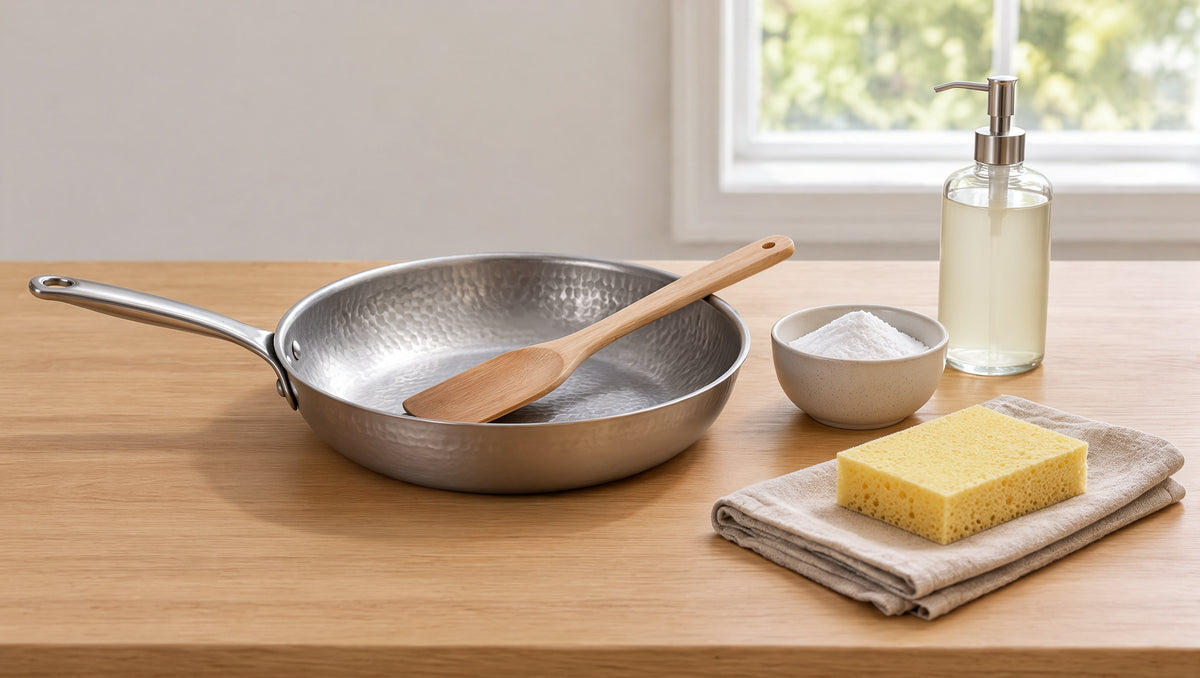
I still had the fish in the pan when I went to plate the rice. By the time I came back, a sticky ring had set on a gold-blue bloom across the hammered floor. It looks worse than it is. How to clean a titanium pan, at least an uncoated one, is mostly patience: let it cool, wash it with hot water and a little dish soap, and simmer off anything that baked on. The rainbow is usually heat tint, not a ruined surface, and you can skip the cast-iron seasoning lecture that sits next to those search results.
The short version
- Confirm you have an uncoated, solid titanium surface. A titanium-reinforced or coated pan needs much gentler care.
- Let the pan cool, then wash with hot water, a drop of dish soap and a regular sponge. Dry it so hard water does not leave spots.
- For burnt food, simmer a little water in the pan and lift the residue. A baking-soda paste handles what is left.
- Skip the Lodge-style seasoning. Use a little fat when you cook. Our listings do not call these pans dishwasher safe, and the wooden-handle saucepan should stay out of the machine.
What kind of titanium pan do you have?
Look at the cooking surface before you pick up a scouring pad. The word on the box is a poor guide. In 2026, Rising Trends pointed out that "titanium" is now used for solid uncoated pans, titanium-strengthened steel, molecular titanium layers and ordinary non-stick coatings with titanium particles mixed in. Those pans do not take the same treatment, and that is why we get photos of "peeling coatings" on pans that never had one.
An uncoated pan is bare metal. You can see the hammered or brushed finish, and there is no film waiting to peel. The Youlva pure titanium hammered frying pan is this kind: the listing describes a pure titanium, uncoated cooking surface in 26, 28 or 30 cm, for induction and gas, sold without a lid. Stuck food can be scrubbed. You are not protecting a coating, because there is not one.
A coated or "titanium-reinforced" pan is a different tool. It may be PTFE or ceramic with titanium in the marketing line, or a patterned titanium interior over an aluminum core. Treat that one like non-stick. Soft sponge, no steel wool, no harsh powders, and usually no metal tools. If the card in the box says "do not use abrasive pads," stop here and follow that card. This guide is for bare metal.
How to clean a titanium pan after everyday cooking
Take it off the burner and let it cool. The Youlva frying-pan listing is blunt about that: allow the pan to cool before cleaning. I still see people park a smoking-hot skillet under a cold tap. It does not clean faster. It just shocks the metal and the handle fittings.
When you can hold the pan comfortably, wash it with hot water, a drop of ordinary dish soap and a sponge or brush. That is the daily job on an uncoated pan. Rinse, then dry it with a towel. Titanium will not rust the way bare iron does, but hard water will leave dull spots if you leave it dripping on the rack. A first wash on a new pan is worth doing properly too. There can be a light packing residue from the factory, and soap gets rid of it before the first meal.
If a little sauce is clinging, fill the pan with warm water and leave it ten minutes, then wipe. Most of what looks baked on after a stir-fry is dried starch or protein. A short soak beats grabbing steel wool first. After eggs, the same rule applies. We already covered that short clean-up in our guide to how to cook eggs in a titanium pan: cool the pan, add warm water, and a soft sponge usually finishes it.
Wash it the day you cook. Food that sits overnight is what turns a two-minute wash into a project. Wipe the handle as well, especially around the neck, or grease collects where your hand goes every night.
How to clean a burnt titanium pan
If you walked away and came back to a black ring, leave the dry scraper in the drawer. Put a thin layer of water in the pan, set it on medium and let it simmer two or three minutes. The water loosens carbonized sauce and stuck protein so a wooden spoon or a metal spatula can lift it. On an uncoated pan, a firm scrape is fair. That is also why a titanium cooking utensil set belongs in the same drawer: the working heads will not chip a film that is not there.
If the ring is still hanging on, add a spoon or two of baking soda to the simmering water and give it a few more minutes, then scrub with a regular sponge or a green scouring pad. Baking soda is mildly alkaline and helps break down browned food without attacking the metal. Rinse it well. The smell of scorched sauce usually leaves with the residue. You should not need a second cleaner for that.
For a truly burnt sugar or sticky glaze, repeat the baking-soda simmer and work the spot with a scouring pad. Stop there if you actually have a coated "titanium" pan. A minute of heavy scrubbing can take the coating off, and nothing puts it back.
Rainbow marks and titanium pan discoloration
The gold, purple or blue sheen after a hot, dry preheat is usually heat tint. Titanium grows a thin oxide film in hot air. The film itself is nearly colorless. You see color because light reflects off the film and the metal underneath and interferes, the same way a drop of oil makes a puddle look rainbowed. A finishing.com discussion of titanium heat colouring, including a note from engineer Ted Mooney, describes that interference clearly. It is not rust. It does not mean the pan is unsafe.
The photos we get of "is this peeling?" are often just that sheen on a new pan after the first hot, dry preheat. A good wash may only fade it. A baking-soda paste, or a brief wipe with diluted white vinegar followed by a soap rinse and a thorough dry, can soften some of the stain. I would rather prevent the next mark than spend twenty minutes on this one. Preheat on medium, add fat once the pan is ready, and keep an empty pan off full power.
Cloudy white spots are a different problem. They are usually mineral deposits from hard water, or leftover salt. Wash, rinse and dry promptly. A little vinegar on a cloth, then a soap rinse, usually clears them.
Do titanium pans need to be seasoned?
No, not the way you season a skillet of iron. We get this question on new pans all the time, and it also turns up on a long-running Outdoors Stack Exchange thread about backpacking pots. The useful part of that discussion is the reason. Seasoning on iron is there to block rust and to build a polymerized oil layer. Uncoated titanium already forms a stable oxide film, and oil does not bond to it the way it does to porous iron. The layer you bake on tends to wash off, then turn sticky, which makes food cling more, not less.
What the pan wants is a little fat at cooking time, and a proper preheat. That is technique, not a curing ritual. If you have been wiping smoking oil around a new pan "to season it," wash the film off with hot soapy water and cook normally. For eggs, use the preheat and fat method in the eggs guide rather than trying to build a Lodge-style crust.
The first use is just as plain. There is no special curing step. Wash the pan with hot water and dish soap, dry it, and make dinner.
Dishwasher, Bar Keepers Friend and what to avoid
Can you put a titanium pan in the dishwasher? Only if the maker says so. The Youlva frying-pan listing tells you to let it cool before cleaning and does not call it dishwasher safe, so hand-washing is the default I would follow if you care about the finish and the warranty card. Dishwasher detergent is alkaline and sits through a long, hot, wet cycle. It can dull a polished surface and leave spots. It is a harder no for the hammered titanium yukihira saucepan. That pan has a wooden handle with a metal collar. Wood does not belong in a dishwasher, and it should not sit in a sink full of water either. The handle end will drink that water, and over time the collar can loosen. Wash the bowl, wipe the handle, and dry both.
Bar Keepers Friend comes up in almost every care thread. The original powder is an oxalic-acid cleanser that the company lists for stainless-steel cookware, porcelain, tile and similar hard surfaces. The official page does not present it as a titanium-pan product, so I would keep it as an occasional stain remover on an uncoated pan, not a daily soap. Sprinkle, rub gently, and rinse thoroughly within a minute, which is what their own directions say. Test a hidden spot first. Skip it on a coated or titanium-reinforced non-stick pan. Do not mix it with bleach, and do not let it dry on the surface.
Most of the ruined pans I hear about failed in this next bit, so the difference is worth putting in one place:
| Care question | Uncoated / solid titanium | Coated or "titanium-reinforced" non-stick |
|---|---|---|
| Daily wash | Hot water, dish soap, regular sponge, then dry | Soft sponge only, no abrasives |
| Burnt food | Simmer water, then baking soda; a scouring pad is usually fine | Soak and wipe; stop before you scratch the coating |
| Metal utensils | Generally fine on a bare metal surface | Usually no; follow the manual |
| Seasoning | Not needed; use a little fat when you cook | Do not bake on oil; it can gum the coating |
| Dishwasher | Only if the maker says so; our listings do not | Only if the maker says so; often hand-wash |
Leave bleach, oven cleaner and anything with chlorine off the pan. They do not help on titanium, and they can attack handle parts, rivets or a wooden grip. Do not pour cold water into a pan that is still smoking. If food still sticks after the surface is clean, the problem is usually heat and fat, not leftover sauce. Go back to the preheat steps in the eggs article before you decide the pan is finished.
Recommended for you

For sauces and soups
Hammered Titanium Yukihira Saucepan
16, 18 or 20 cm, wooden handle, pouring lips. Hand-wash the bowl and keep the handle out of the dishwasher. $69.99.
View product
For turning and serving
Titanium Cooking Utensil Set, 4 Pieces
Solid wok spatula, slotted turner, ladle and perforated skimmer, titanium heads with stainless handles. $99.99.
View productHow to clean a titanium pan FAQ
How do you clean a burnt titanium pan?
Let it cool a little, then simmer a thin layer of water in the pan for a few minutes and lift the residue. If it is still stuck, add baking soda to the water, simmer again and scrub. On an uncoated pan you can use a scouring pad. On a coated pan, stay with a soak and a soft sponge.
Can you put a titanium pan in the dishwasher?
Only when the manufacturer says it is dishwasher safe. The Youlva frying-pan listing does not, so I would hand-wash it. Keep any wooden handle out of the dishwasher.
Do titanium pans need to be seasoned?
Uncoated titanium pans do not need a cast-iron seasoning layer. Wash them, preheat them, and use a little oil or butter when you cook. A baked-on oil film often turns sticky and washes off anyway.
Can you use Bar Keepers Friend on titanium pans?
On an uncoated pan, a short, gentle pass can help with mineral spots and some stains if you rinse it off promptly, as the label directs. Do not use it on a coated or titanium-reinforced non-stick pan, and do not leave it sitting on the metal.
Why is my titanium pan discolored or rainbow?
Those gold, purple or blue marks are usually heat tint from a thin oxide film, not rust. They often appear after a hot, dry preheat. They may not come off completely. Use medium heat and add fat once the pan is ready to reduce new marks.
How should I clean a titanium frying pan and a wooden-handle saucepan?
Wash the frying pan and the saucepan bowl with hot soapy water after they cool. Wipe the wooden handle separately, and do not leave it standing in a sink of water. Never run that saucepan through the dishwasher. Dry both pieces before you hang or stack them.
Food still sticks after I clean the pan. Is it ruined?
Usually not. Uncoated titanium needs a proper preheat and a little fat, especially for eggs. If the surface is clean, the sticking is almost always technique. See our guide on cooking eggs in a titanium pan.
Pick the frying-pan size you actually cook in tonight, then add the wooden-handle saucepan if you want a smaller pot for sauces and soups.
Browse Compact Cooking & Food PrepSources
- Rising Trends, Titanium Cookware Trends 2026, how the word "titanium" is used for several different pan constructions, US search figures as of July 2026, article updated 26 October 2026.
- finishing.com, Titanium Heat Colouring, heat tint as a thin oxide film whose colors come from light interference, including Ted Mooney's note.
- Outdoors Stack Exchange, Can or should you season titanium cookware?, the common seasoning question and why rust protection is not the same job as on cast iron.
- Bar Keepers Friend, Cleanser, oxalic-acid powder listed for stainless-steel cookware and similar hard surfaces, and the direction to rinse thoroughly within a minute.
Specs and prices checked on the product listings 2026-11-15 (Asia/Shanghai). Always follow the care notes that came with your own pan.